
Is it just a load of old stones and pots?
A guest post from author Alison Morton to celebrate the launch of her new Roma Nova novel, HEROICA
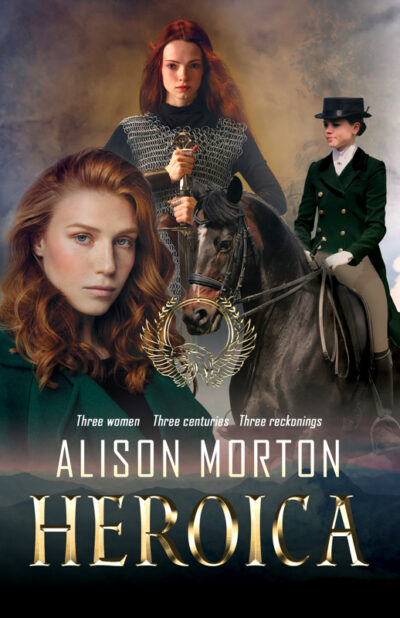
Today I’ve handed over the reins to Alison Morton. Alison writes award-winning thrillers featuring tough but compassionate heroines. Her twelve-book Roma Nova series is set in an imaginary European country where a remnant of the Roman Empire has survived into the 21st century and is ruled by women who face conspiracy, revolution and heartache but use a sharp line in dialogue.
She blends her fascination for Ancient Rome with six years’ military service and a life of reading crime, historical and thriller fiction. On the way, she collected a BA in modern languages and an MA in history.
Alison lives in Poitou in France, the home of Mélisende, the heroine of her three contemporary thrillers, Double Identity, Double Pursuit and Double Stakes.
***
Why do I insist on clambering over old stones, foundations of buildings or paving slabs dating back 2,000 years? Or touching funny concrete, remnants of wall paintings or bits of mosaic? And looking at broken bits of pottery and metalwork? And sometimes staring at beautiful whole glass and marble creations that I can’t possibly understand how they were made?
We seem to trip over hoards (or hordes?) of this ‘stuff’ whichever part of the ex-Roman territories we visit. Sometimes it’s breathtakingly beautiful; other times just a load of broken amphorae.
It’s basically about people
Who touched these things? Who made them? And the big questions – why did they make them? The impact of the Roman world is often one of “We did the Romans, Tudors and Nazis at school.” Romans were blokes in tunics, overlapping ribs of metal, helmets and used a gladius to conquer [insert place of choice]. This is often the Hollywood depiction and can irritate the Hades out of historians and historical fiction writers.
Rome went from a grubby little village or two to a world superpower and dwindled into a few acres of land around Ravenna. But it took 1,229 years and apart from the literature, plumbing and administrative processes, etc. (see the Monty Python video), they left an enormous amount of ‘stuff’ behind them.
Aqueducts, road, barracks, fora, temples, basilicae are a small part. What really tells us about them are is the sheer variety, quality and complexity of their cooking and medical utensils, gambling games, hairpins, lamps, nails, taps, glassware, (inevitably) pots and bowls, chains, furniture, food remains, woodwork tools, coins, handles, locks, ingot moulds, rings, bracelets and necklaces, horse decorations and remnants of armour, weapons and even textiles. All these things were made, worn, consumed, repaired or discarded by every level of society.
Why These Finds Matter
Taken together, these discoveries are reshaping narratives about:
- Urban life and aesthetics – frescoes in London challenge us to imagine cities in colour, not just stone.
- Economy and production – industrial complexes in Britain remind us that Roman logistics were as much about craft and supply as about conquest.
- Military presence and cross-cultural contact – Roman camps and the villages that grew up round them suggest a significant level of cooperation rather than purely coercive imperialism.
- Religion and symbolism – sanctuaries and ceremonial objects show how Romans engaged with spiritual life in provincial contexts.
Each find is a story not just of objects, but of people – of craftsmen, soldiers, merchants, and worshippers – whose lives intersected with the grand sweep of imperial history yet left traces most of us only glimpse centuries later.
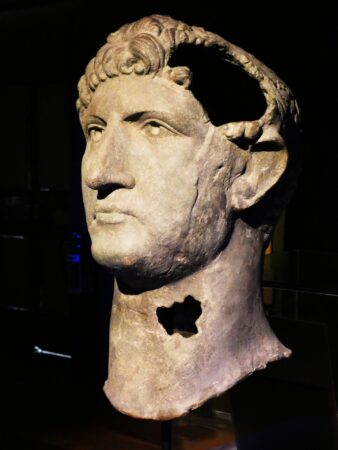
Photography taken by Jane Davis at Mudlarking exhibition of items found in the Thames
The world’s most difficult jigsaw puzzle
In the heart of modern London – in a construction site in Southwark by the Thames — archaeologists from MOLA (Museum of London Archaeology) uncovered one of the most extensive painted Roman walls yet found in the city. Conserving it is described as assembling the world’s most difficult jigsaw puzzle. These fragments, discarded deliberately into pits during ancient demolition, show rare colour and artistic texture in a city usually imagined only in plain stone and tile. The high-status nature of the building, inferred from the quality of paint and plaster, hints at a more visually vibrant Roman London than the monochrome worlds we often reconstruct.
A Vast Industrial Footprint on the Wear
Further north, near Sunderland in northeast England, an unexpected find has transformed our sense of Roman military logistics. Archaeologists and local volunteers uncovered a monumental industrial complex on the banks of the River Wear, marked by over 800 stone sharpening tools – a scale of production previously unseen in Roman Britain. More than just a military outpost, this complex seems to have been a hub of production supporting army units across the region, revealing just how embedded Roman infrastructure was in the landscape.
Austria – Not merely a borderland of legions and fortresses
Moving to my favourite area of former Noricum, roughly today’s Austria to renovations deep beneath Salzburg’s historic centre (former Iuvavum). Archaeologists working ahead of museum renovations made a spectacular discovery: a model bronze ram (rostrum) from a Roman warship, carefully cast to scale. This object is unusual because metal artefacts of this size and quality are almost always melted down in antiquity or later periods. Its survival – buried under collapsed villa walls – makes it unique and offers a rare glimpse into Roman symbolic practices.
What is a naval ram doing in a landlocked Alpine town? It isn’t practical. It isn’t local. It’s likely to be ideological or ceremonial – a piece of imperial language transplanted into a provincial domestic setting. It could merely be a souvenir of a trip to Rome itself, but also a statement of affiliation with Roman power and prestige, displayed in a private context. Perhaps that tells us about how provincial elites saw themselves – and wanted to be seen.
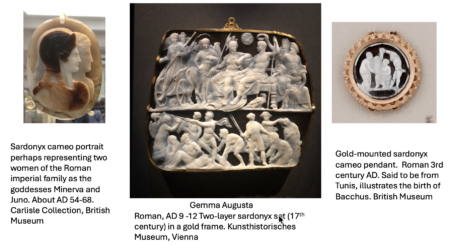
Examples of Roman cameos taken in London and Vienna by Alison Morton
A Rare Medusa
In 2025, archaeologists announced the discovery of a Roman-era cameo depicting Medusa during excavations associated with construction work at a new funicular railway station. The cameo, exquisitely carved from black and white banded agate or onyx and dated to the 2nd century AD, was likely to have been crafted in the Adriatic city of Aquileia so the sort of piece you expect from workshops in northern Italy, not from an Alpine settlement far from any legionary base.
And that’s precisely why it matters. This wasn’t military equipment, nor trade pottery, nor utilitarian debris. It was personal adornment. Luxury. Identity. A choice. Someone in this mountainous region, far from the formal centres of Roman administration, was wearing an object that connected them stylistically and culturally to the wider Roman world.
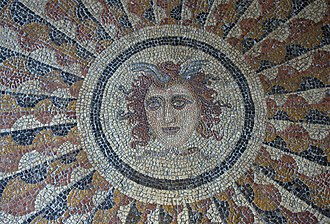
Central motive of the Medusa mosaic, 2nd century BCE
Jebulon, CC0, via Wikimedia Commons
Yet another Roman villa!
In June 2025, archaeologists from OÖ Landes‑Kultur GmbH and the University of Salzburg uncovered a Roman villa complex on Reinberg Hill in Thalheim bei Wels. The site spans over 1,000 m² and includes three well-preserved mosaic floors dating to the 2nd century CE. The most notable mosaic features an aquatic scene with two dolphins, an exceptionally rare find in Upper Austria. Another mosaic depicts a wine‑mixing vessel (krater), while a third, partially excavated, displays geometric patterns. The villa overlooks the ancient Roman town of Ovilava (modern Wels) which later became the capital of the newly established province of Noricum Ripensis.
Such flooring – often reserved for elite spaces – points to a villa of significant wealth and status within the provincial landscape. These mosaics not only tell us about aesthetic tastes in this part of Roman Austria but also about economic and cultural connections that would have linked this villa to broader stylistic currents in the western provinces. We are here, we are settled, we are prosperous enough to decorate our floors with art.
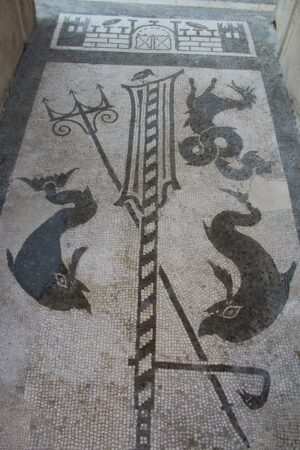
Scavi archeologici di Pompei (Pompeii) 06.jpg
Via Wikimedia Commons under a Creative Commons Licence
A common culture based on shared values and aspirations
Taken together, these finds – from intimate luxury goods to grand mosaics and military workings and remains via symbolic artefacts and coloured walls – paint a more nuanced portrait of Roman life beyond Italy whether in Noricum beyond the Alps or the far off province of Britannia. I wonder what a future archaeologist will be as fascinated by our 21st century ‘stuff’.
Alison’s latest novel HEROICA is out now!
Even the strongest state is vulnerable to its past
2020, Roma Nova. Carina Mitela investigates a potential rebellion but discovers the long-buried secret that ignited the attempted uprising links directly to her own powerful family.
1683, Vienna. As Europe struggles against the Ottoman onslaught, Honoria Mitela leads her troops into the desperate battle to save besieged Vienna. The fate of Europe – and of Roma Nova itself – hangs in the balance.
1849, Central Italy. Statia Mitela’s impulsive act saves one life but jeopardises Roma Nova’s very existence and threatens her descendants with public disgrace, financial ruin and permanent exile.
Three stories of the women of the Mitela family, descendants of the founders of Roma Nova, bound by blood and courage.
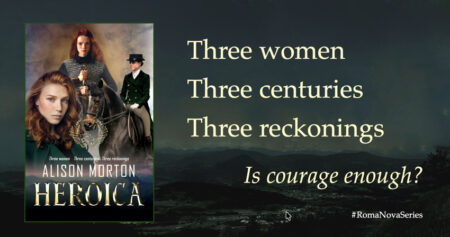
Buying links for HEROICA
Amazon: https://mybook.to/HEROICA_RomaNova
Other retailers: https://books2read/HEROICA
For the latest news, subscribe to Alison’s newsletter at https://www.alison-morton.com/newsletter/ and receive ‘Welcome to Alison Morton’s Thriller Worlds’ as a thank you gift.
Social media links
Connect with Alison on her World of Thrillers site: https://alison-morton.com
Facebook author page: https://www.facebook.com/AlisonMortonAuthor
Alison’s writing blog: https://alisonmortonauthor.com
Instagram: https://www.instagram.com/alisonmortonauthor/
Goodreads: https://www.goodreads.com/author/show/5783095.Alison_Morton
Alison’s Amazon page: https://Author.to/AlisonMortonAmazon
Threads: https://www.threads.net/@alisonmortonauthor
BlueSky: https://bsky.app/profile/alisonmorton.bsky.social
Twitter/X: https://twitter.com/alison_morton @alison_morton
Newsletter sign-up: https://www.alison-morton.com/newsletter/
Press
Want to be featured?

Host a bookclub

Latest books










Read an excerpt

Author Member of The Alliance of Independent Authors
