
About: Jane Davis

Hailed by The Bookseller as ‘One to Watch’, Jane Davis writes thought-provoking literary page turners with razor sharp dialogue and a strong commercial edge. She spent her twenties and the first half of her thirties chasing promotions in the business world but, frustrated by the lack of a creative outlet, she turned to writing. Her first novel, 'Half-Truths and White Lies', won a national award established with the aim of finding ‘the next Joanne Harris’. Further recognition followed in 2016 with 'An Unknown Woman' being named Self-Published Book of the Year by Writing Magazine/the David St John Thomas Charitable Trust, as well as being shortlisted in the IAN Awards, and in 2019 with 'Smash all the Windows' winning the inaugural Selfies Book Award. Interested in how people behave under pressure, Jane introduces her characters when they are in highly volatile situations and then, in her words, she throws them to the lions. The themes she explores are diverse, ranging from pioneering female photographers, to relatives seeking justice for the victims of a fictional disaster. A common thread that runs through her writing is the impact of missing persons on our lives, how the hole they leave behind can be so great that it dwarfs the people actually left behind. In 'I Stopped Time', it was an estranged mother. She addressed the theme head-on in 'A Funeral for an Owl', with teenage runaways. And in 'These Fragile Things' mother Elaine is obsessed by the child she lost to a miscarriage, almost to the exclusion of the child she has. Her latest novel, 'At the Stroke of Nine O’Clock', was published in July 2020. Set in post-war London, and featuring three very different women whose worlds collide, it has been featured by The Lady Magazine as one of their favourite books set in the 1950s, selected as a Historical Novel Society Editor's Choice, and shortlisted for the Selfies Book Awards 2021. Jane Davis lives in Carshalton, Surrey, in what was originally the ticket office for a Victorian pleasure gardens, known locally as ‘the gingerbread house’. Her house frequently features in her fiction. In fact, she burnt it to the ground in the opening chapter of 'An Unknown Woman'. It continues to provide a rich source of inspiration. Her work in progress asks the question why one man would choose to open a pleasure gardens at a time when so many others were facing bankruptcy. When she isn’t writing, you may spot Jane disappearing up the side of a mountain with a camera in hand.
Recent Posts by Jane Davis
Is it just a load of old stones and pots?
Today I’ve handed over the reins to Alison Morton. Alison writes award-winning thrillers featuring tough but compassionate heroines. Her twelve-book Roma Nova series is set in an imaginary European country where a remnant of the Roman Empire has survived into the 21st century and is ruled by women who face conspiracy, revolution and heartache but…
» Continue Reading
Letting in the Light
“Before reading, the world is experienced; after, it becomes interpretable as well.” ~ JC Monnerville I’ve spent the last four years writing about two great readers, James and Dorcas Lackington. James wrote in his first memoir that his wife was “ immoderately fond of books.” In fact, it was the thought to reading to and…
» Continue Reading
When Bookselling was a Dangerous Business
In 1789, George III’s recovery from illness triggered nationwide celebrations that “exceeded every thing before known.” But were they really “grateful testimonies of a nation’s love”? On 3rd April, the King issued a Royal Proclamation ordering that a day of thanksgiving be observed throughout the Kingdom to mark his recovery. Coupled with his first public…
» Continue Reading
Putting the Temple of the Muses back on the map
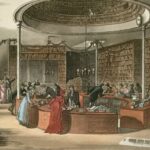
The Temple of the Muses was probably the largest single shop in 18th Century England. James Lackington’s trade card boasted it was “the finest shop in the world”. Arguably, Josiah Wedgwood’s intimate London showroom was more luxurious, showcasing his ceramics as if they were works of art, and admired by his elite clientele, including royalty….
» Continue Reading
The Longest Scandal in British History: Britain’s Forgotten Atomic Veterans
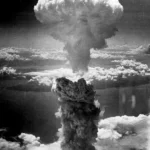
The main protagonist in my novel, My Counterfeit Self, is Lucy Forrester, a political poet and activist. Having been anti-establishment all of her life, she’s horrified to find that she’s been featured on the New Year’s Honours list. Her inclination is to turn it down. But what if it’s an opportunity… WB Yeats said that…
» Continue Reading