
Putting the Temple of the Muses back on the map
Solving the Location Puzzle of the Temple of the Muses

The Temple of the Muses was probably the largest single shop in 18th Century England. James Lackington’s trade card boasted it was “the finest shop in the world”. Arguably, Josiah Wedgwood’s intimate London showroom was more luxurious, showcasing his ceramics as if they were works of art, and admired by his elite clientele, including royalty.
But with its vast ware-room and sweeping staircase leading to lounging galleries, the Lackington’s four-storey emporium was radically different. At a time when most booksellers kept stock behind counters, here, browsing was encouraged and customers were allowed to read freely before they made a purchase. The Temple of the Muses redefined shopping as entertainment and a leisure activity. Harrods, Whiteley’s and Selfridges would follow in its wake.
At 12 Greek Street, Soho, a plaque pinpoints the site of Josiah Wedgwood’s London showroom, but there is nothing similar for The Temple of the Muses. Recreating the Lackington’s bookselling world in Georgian London required a lot of detective work and a leap or two of faith.
The Chiswell Street Years
The address of Lackington’s original bookshop was 46 and later 46-47 Chiswell Street, Moorfields. Vistiors will find the street much altered. Only Whitbread’s vast brewery and a handful of listed 18th-century buildings remain.
Opposite the brewery stands a terrace of yellow brick Georgian houses numbered 42 – 46 and dating back to 1774 having been rebuilt after a fire. If the street numbering remains unchanged (a moot point), this means James Lackington moved into the premises shortly after it was rebuilt.
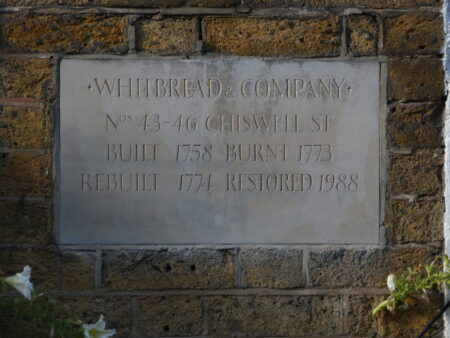
Unfortunately, before the terrace was listed by English Heritage, number 47 was replaced by a modern building that looks a bit like a cinema (confusingly numbered 48)!
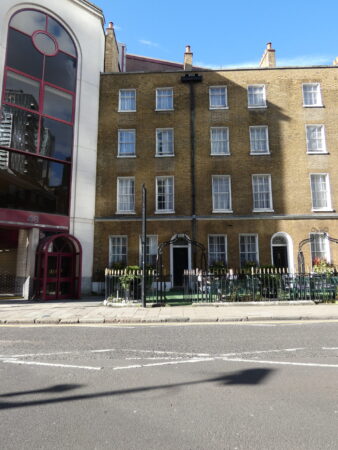
Where else could I find a snapshot of Chiswell Street in the 18th Century?
Tallis’s London Street Views
In the years 1838 and 1840, John Tallis, a publisher of maps and prints, embarked on a Herculean endeavour. He set out to create a guidebook for “strangers visiting the metropolis”, featuring every shop, church, public building and house. The result was Tallis’s London Street Views. Imagine a Victorian Google Street View, but painstakingly hand-drawn, with every architectural detail, down to the signwriters’ work. Tallis only completed eighty-eight streets before he exhausted his funds – but the streets he captured in such remarkable detail included Chiswell Street.
By the time Tallis executed his drawings, Lackington’s was no more. Soon, some streets he captured in exquisite detail would be demolished to make way for railways and Victorian building projects. What remains is a snapshot of the economic life of the street, frozen in time. The ironmonger, John Dale, kept his warehouse at numbers 12 and 13, with competition from John Pare, a wholesale ironmonger at numbers 18 and 19. M Highan, Stationer and Bookseller operated from 34 – 37, Grant’s Leather Warehouse from number 17, Kyder and Sons Tobacco, Snuff, and Cigar, Manufacturers from 57 – 59, and Terry’s Carpet Warehouse from number 79.
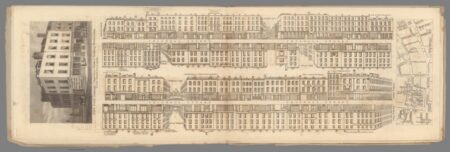
Given the wealth of detail Tallis has given us, you might think that locating numbers 46 and 47 would be a breeze. Unfortunately he was selective. He depicted numbers 1 – 37 and 53 – 91, but numbers 38 – 52 are missing!
Whitbread’s Brewery
Because so many of the buildings in Chiswell Street were under the ownership of Whitbread’s Brewery, that is where I continued my search. Lo and behold, I was able to trace a 1974 photograph held by the London Picture Archive showing 47 and 48 Chiswell Street. (Image under copyright, but you can view it at the link.)
Having seen this, I felt confident that I could describe Lackington’s bookshop in The Bookseller’s Wife and The Temple of the Muses as being in the shadow of Whitbread’s Brewery.
From Chiswell Street to Finsbury Square
Lackington’s catalogues show that their stock of books increased year on year. By the 1790s they were fast outgrowing their Chiswell Street shop, but with Samuel Whitbread owning the properties on either side, there was no scope to expand. Doubtless, they would have been scouting for the right location.
Immediately to the east of Chiswell Street lies Finsbury Square. Then a new garden square, it was built on what was Upper Moorfields to cater for London’s rapidly expanding professional (middle) class, including medics who wanted to live close to the hospitals where they worked.
In 1768, the City had acquired a long lease for the Finsbury Estate, which covered the area between London Wall and Old Street, and from Whitecross Street to what is now Bishopsgate. In the same year, George Dance the Younger succeeded his father as Clerk of the City Works. He had a vested interest in the Finsbury area. His family home was in Chiswell Street.
A number of ambitious blueprints were drawn up. One covered a large area from Old Street in the north, The Curtain in the east, Chiswell Street and Middle Moorfields to the south, and Bunhill Row in the west. It included three circuses, an elliptical circus, a crescent, various squares and ornamental fountains and monuments (CLRO, Surveyor’s City Lands Plan 1144). An even more complex scheme (CLRO, Surveyor’s City Lands, 1146), incorporated the Artillery Ground. Wise to the plans, the Artillery Company acted decisively to protect its interests, acquiring the Artillery Ground from the City in 1775. As a planning objection, this proved effective. The grounds and its buildings are still there to this day.
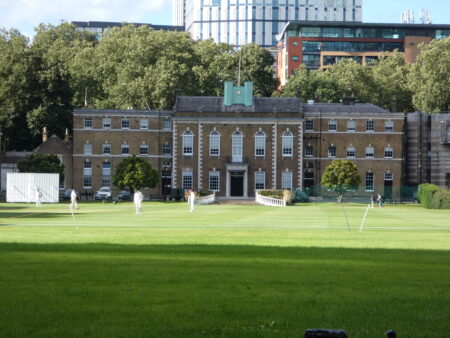
Had either scheme been built, the area between Liverpool Street Station and the Barbican would look rather like Bath. As things stood, those to the east of the Artillery Ground, Lackington’s included, must have been rattled by the threat that Chiswell Street would fall victim to a grand design.
George Dance’s design for Finsbury Square was a quadrangle of houses built around a pond, the northern end of a development called the ‘London Amphitheatre’.
“It was originally intended to form a piece of water in the middle, but the fear that this might prove insanitary caused the idea to be abandoned, and a garden was substituted.” ~ Ellis, History of Shoreditch.
Gentrification of Upper Moorfields took place over two decades, commencing in 1772 with the construction of houses on the west side – what became known as Finsbury Pavement.
Work didn’t begin on the north side of the square until 1789. Perhaps it took time to uproot existing residents and raise the necessary funds. It is also likely that out of necessity, the City put new development on hold while the extensive damage caused by the Gordon Riots was repaired.
Before construction of the east side began in 1790, the garden was laid out, affording the new residents of the west and north sides protection from ongoing building works.
Finally, in 1791 the terraced houses to south side were built. Some commentators thought they had been shoddily executed, but Sir John Soanes appears to have been impressed. In his lecture to the Royal Academy on 16 March 1815, he condemned “speculative building”, using Finsbury Square as an example that “held out some prospect of a return to a better style of building.” Mrs Burney wondered to Dr Johnson why anyone would want to build some very beautiful new buildings between Bedlam (London’s asylum for the insane) and St Luke’s Hospital for Lunatics.
But Finsbury was no longer be a disreputable outpost, but a fashionable destination.
We know from records held in Sir John Soane’s Museum Collection exactly who the lots were let to.
“Finsbury / Square, North, South, East and West, streets labelled, S side labelled Lot 1 to Lot 11, Wm Rolfe (three times), Wm Lovering (twice), Wm Butler with Wm Fielder (twice), E side labelled Lot 14 to Lot 23, N side with Worship Street behind labelled Lot 1 to Lot 13, Let to Peter Banner 1st July 1789, Let to Wm Rolfe 1st July 1789, Let to Jas (James) Peacock 29th July 1789 (twice), Let to Jas Carr 29th July 1789, Let to Anthony Moorland 29th July 1789 (five times), Let to Tho Silk 29th July 1789, Let to Wm Robinson Esq., 29th July 1789, Let to Wm Robinson Esq. 29th July 1789, W Side (in front of the Artillery Ground) labelled unbuilt, M Jones and Mr Bailey.”
A plot wasn’t assigned to James Lackington. So how did he come to acquire one of such a considerable size – 140 feet wide and 40 feet deep?
The Second Caslon Type Foundry
Several sources confirm how James Lackington came to buy a premises on Finsbury Square. It had only recently been acquired (or possibly built for) William Caslon III, grandson of the famous typefounder. James Lackington would have known William, at least by sight, since he worked at the type foundry at 26 Chiswell Street and lived at the family home at 62 Chiswell Street before moving to 12 Finsbury Place (Sun Fire Office insurance records 1792).
Frustrated by his mother’s refusal to modernise the family type foundry and its fonts (which she considered to be her late husband’s legacy), William chose to strike out on his own. In 1792, he sold his share in the business for £3,000 to his mother, known as the Widow Caslon, and his brother Henry’s widow, who had inherited Henry’s share. With the proceeds, William bought the Dorset-Street foundry belonging to the late Joseph Jackson, a former student of his grandfather, William Caslon I.
“…After leaving his mother in Chiswell‑street he established a foundry in a large building in Finsbury‑square, afterwards well known as ‘The Temple of the Muses’ of Lackington, Allen, and Co. the eminent booksellers.” ~ The Gentleman’s Magazine, Volume 93, Part II (July–December 1823)
Trading as W Caslon and Son and putting himself in direct competition to such a prestigious family business was a gamble. £3,000 is approximately £587,000 in today’s money. Although property prices were far lower, giving him greater purchasing power, William over-stretched. On 5 January 1793 he was declared bankrupt.
The prospect of a premises on one of London’s fashionable new squares, in an area where his name was already known was too enticing an opportunity for James Lackington to resist.
“At the sale of Mr. Caslon’s effects, Mr. Lackington bought the house for £4100.” ~ The History of the Squares of London : Topographical & Historical by E Beresford Chancellor
“Sometime afterwards Mr Caslon removed them again to Dorset Street, and his house in Finsbury Square was converted by the celebrated bookseller, Mr Lackington, into ‘Temple of the Muses.’” ~ Typographia by T Hansard, published 1825
With sufficient funds to move his foundry back to its original premises at 107 Dorset Street, William Caslon III made his son William IV his partner, allowing him to retire in comfort in 1807.
Although I haven’t been able to trace any plans, it is clear that the Lackingtons embarked on a grand building project. But a vital piece of the jigsaw was still missing.

What was the exact location of the Temple of the Muses?
Written just three years before the building was destroyed by fire, Tallis’s guide places The Temple of the Muses on a bold corner plot:
“Finsbury Place is a broad handsome Street extending from Finsbury Square to Moorgate, whence has lately been erected an avenue of stately homes, to the back of the bank called Moorgate Street. At the corner of this place and the square is an extensive building for many years occupied by the celebrated Lackington, since tenanted by Messrs Jones and Company.”
The question is, which corner?
The Postal Address
James Lackington wasn’t shy about blowing his own trumpet. He even struck his own coins – perhaps the first book tokens – with his profile on them. Lackington’s many publications and imprints refers to the business address as Finsbury Square. Parties writing to Lackington’s – among them the poet Percy B Shelley – simply addressed their correspondence to Messrs. Lackington & Co., Finsbury Square, London. A building with a frontage of 140 feet and topped with a dome, wouldn’t have been hard for the postboy to find. Contemporaries wrote that it was visible in the skyline from all over Moorfields.
Unfortunately, the lack of clarity makes it hard to pinpoint its exact location, as I suspect others have found! Some sources give the address 32 Finsbury Square, whilst the address used by J Jones Publishers who took over the premises from Lackington, Hughes, Harding, Mavor & Jones was 32 Finsbury Place, Moorfields. This is an important distinction. Of course, it is possible that both are correct. The numbering of Finsbury Square and its surrounding streets has almost certainly changed.
Sources which state it was on the south-eastern corner
Folio, a business located at 38 Finsbury Square, claims that it trades from the site of the Temple of the Muses, but Google maps shows number 38 is on the south-eastern corner, at the junction of Dean Street and Wilson Street.
That said, I can’t disregard a source as reputable as The London Museum who agree – of course, their website may be where Folio found their information. But what source did the museum rely on? It may have been this:
“If we cannot identify Finsbury Square with any illustrious residents, we can at least connect it with one whose sense of his own importance almost bordered on eccentricity ; for here for a time Lackington, the bookseller, kept what he termed “The Temple of the Muses,” at a house in the south-east angle of the Square, which had previously been occupied by Mr. Caslon…” ~ The history of the squares of London : topographical & historical by E Beresford Chancellor
But the book was published in 1907. I needed eye witnesses.
Sources that support the case for the south-western corner
Richard Horwood
Between 1792 and 1799, Richard Horwood undertook a survey of “the Cities of London and Westminster, the Borough of Southwark, and Parts Adjoining, Shewing Every House.”
“The execution of it has cost me nine years of severe labour and indefatigable perseverance, and these years have formed the most valuable part of my life. I took every angle, measured almost every line, and, after that, plotted and compared the whole work.” ~ Richard Horwood
The resulting map is a marvel, but it doesn’t show a building of any size on the south-eastern corner of Finsbury Square – certainly not one with a 140-foot frontage. However, we do see an elongated building on the south-western corner, and an entrance leading to a stable yard, which would have been essential for deliveries, given that the Temple of the Muses stocked 500,000 books, and its policy of selling at the cheapest price while still making a profit relied on rapid sales.
Could that be our location?
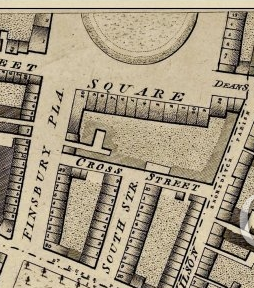
Extract from Horwood’s folding map, 1799, via Wikimedia Commons.
Ackermann, 1809
Rudolph Ackermann’s 1809 description found in The Repository of Arts, Literature, Commerce, Manufacturers, Fashions and Politics also points to this compass point:
“This magnificent structure is situated at the S.W. corner of Finsbury-square, and was fitted up for the reception of books in the year 1794.”
The Northern Star Account of the Fire that Destroyed the Building, 1841
Some of the most compelling evidence comes from the Northern Star’s report of the fire:
“Destructive Fire in London. —On Tuesday morning , at ten o’clock, a fire originated on the premises of Messrs. Painter and Co., the extensive cabinet-manufacturers, Finsbury-Pavement, Moorfields, which has involved the total destruction of that spacious building.”
I hadn’t encountered the name Finsbury Pavement on Horwood’s map, because the name wasn’t adopted until the 19th Century, replacing Finsbury Place South. The name that remains today, so we know exactly which road is referred to.
“Nearly the whole of the premises now destroyed formerly belonged to the far-famed bookseller, Mr. Lackington… During his occupancy of the spacious premises in Finsbury-square… a dome containing several galleries filled with a vast assortment of books.”
And
“Houses on the west side of the Pavement , opposite the premises burned down , No. 1 , belonging to Messrs Cater and Wood , part damaged by fire; No 2 , Mr Evans ; No 3 , Mr . Reymond ; No 4, 5, 6, 7, 8 and 9, similarly damaged.”
Because Horwood’s plan shows house numbers, this suggests that the elongated building is the Temple of the Muses, a conclusion that parties responsible for renaming Cross Street Lackington Street in 1937 may have reached.
The following content may explain the numbering on the plan.
“By this time , however , the house adjoining the Messrs. Painter’s, which was occupied by a medical man, at the corner of Finsbury Square, caught fire.“
And
“The premises of Dr. Shoveller, No . 50, adjoining, and at the corner of Finsbury-square, are completely gutted.”
I wondered if, during the Lackington’s occupation, the shop extended the whole way to the corner, but had only since been converted for use as a private residence.
That would mean that in this 1828 etching sourced from Wikimedia Commons (drawn by Thomas Hosmer Shepherd and engraved by William Wallis, 1828) the houses we see to the left form the northern edge of Finsbury Square. Both Dean Street and Wilson Street at the south-eastern corner are simply too narrow.
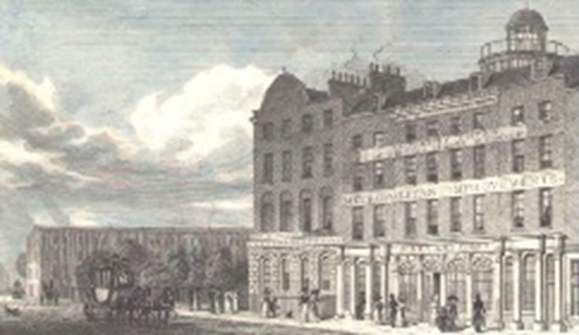
Planning Application, 1858
In 1858, 17 years after the fire, Mr Henry Carter applied for planning permission for a warehouse occupying the site at Wilson Street, Cross Street and Finsbury Square. The London Picture Archive has a number of plans for the various elevations.
I imagine this represents the entire area that was gutted by the fire, however, it is also possible that The Temple of the Muses with its warehouses and printworks extended into the unmarked area we see on Horwood’s plan, which is not divided into plots.
The London Archives
With a background in insurance, you might think I would have thought of broadening my search earlier. In a single ledger of the Sun Life Office dated 1793/4, I found the following:
“No. 4274
£16.00
James Lackington Allen & Co of Finsbury Square Booksellers
On their Stock and Utensils Viz. In Mr Lackington’s dwelling house in Finsbury Square and in their Shop, Warerooms and Offices in Finsbury Place all adjoining & communicating Brick not exceeding Eight Thousand pounds — £8000″
Here was the confirmation I needed that James Lackington owned the dwelling house on Finsbury Square, and the adjoining shop, warerooms and offices that extended into Finsbury Place.
But then I struck gold. An insurance policy for Robin Allen, a partner in the business, which shows the postal address, not as 32 Finsbury Square or 32 Finsbury Place, but 50 Finsbury Square!
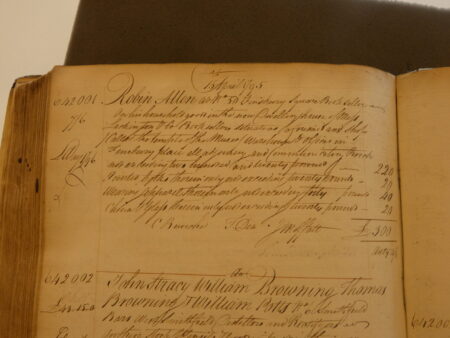
“No. 42001
1/6
Robin Allen at No. 50 Finsbury Square Bookseller
On his household goods in the now Dwelling house of Mr Lackington & Co. Booksellers situate as aforesaid and shop called the Temple of the Muses, Warehouse & Offices in Finsbury Place all adjoining and communicating Brick not exceeding two hundred and twenty pounds.”
I could now say with absolute confidence that James Lackington owned the house on the south-west corner of Finsbury Square and that The Temple of the Muses adjoined the house and extended into Finsbury Place South.
What’s more, The London Archives had a large-scale copy of Horwood’s 1799 map, which clearly showed that the bold corner plot is numbered 50.
A Blue Plaque?
Surely there should be something to honour the life’s work of the Lackingtons, who were instrumental in making books accessible to everyone, not just the privileged few? And isn’t the National Year of Reading the right time to honour their life’s work?
I have made enquiries with English Heritage, who advise that they only put blue plaques on authentic surviving structures – buildings actually lived or worked in by the people they commemorate. Some exceptions have been made, for example, in Chiswell Street, a blue plaque has been erected to honour William Caslon’s Type Foundry. I am told that Islington council operate a heritage plaque scheme, so that will be my next port of call.
The Chiswell Street Chronicles

“Most historians agree that James Lackington invented the bookshop as we know them today. But few will talk about the woman who worked tirelessly at his side.” ~ Davida Chazan, The Chocolate Lady’s Book Blog
Read part one of Dorcas Lackington’s story in The Bookseller’s Wife.
London, 1775. Books have always been Dorcas Turton’s refuge—but now they may be her salvation.
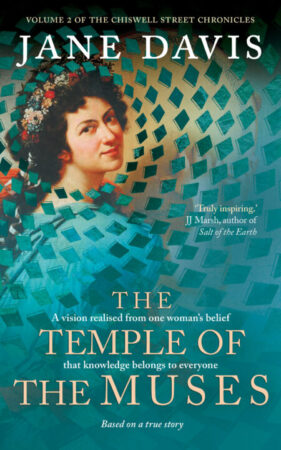
Read part two to Dorcas Lackington’s life in The Temple of the Muses.
“A fascinating read for anyone who loves books and bookshops – and it’ll make you very glad you live in the present day without our easy and affordable access to books in many formats.” ~ Jayne Sims
A vision realised from one woman’s belief that knowledge belongs to everyone…

Press
Want to be featured?

Host a bookclub
Latest books








Read an excerpt
Author Member of The Alliance of Independent Authors
