
Inequality in the eyes of the law
Was the Ruth Ellis trial a miscarriage of justice?

My novel, At the Stoke of Nine O’Clock, is the result of a long-held fascination with one woman.
I first became aware of Ruth Ellis (pictured below) when I was a teenager. Ruth was that rarity: a female killer. Women, as we know, are far more likely to be victims rather than killers. (Arguably, the two are not mutually exclusive.) And unlike their male counterparts, women who kill tend to know their victims. This was the case with Ruth. ‘Six revolver shots shattered the Easter Sunday calm and a beautiful platinum blonde stood with her back to the wall. In her hand was a revolver…’ I was hooked by the story of the blonde hostess who shot her lover in cold blood, then calmly asked a bystander to call the police.
“The traditional female role is a nurturer, not a murderer. Extreme violence is far more alien to females than to males.” ~ James Alan Fox, criminologist
The other fact that drew me to Ruth is the legacy she leaves behind. The last woman in Great Britain to be hanged, her execution on 13th July 1955 was a crucial turning point in the movement for the abolition of the death penalty in the UK.
It was shortly after learning about her that I first read, Ruth Ellis: A Case of Diminished Responsibility by Laurence Marks and Tony Van Den Bergh. Published in 1977, the book’s title is provocative, referencing the partial defence of diminished responsibility, introduced in 1957 as a result of the public outcry following Ruth’s execution. I read it again when researching At the Stroke of Nine O’Clock. If ever you want evidence of how attitudes towards women have changed, this is the book you should turn to. It troubles me that I wasn’t more appalled by the language at the time.

Ruth’s case is often cited as an example of a miscarriage of justice. 2025 marks the seventieth anniversary of her execution, and her grandson Stephen Beard has instructed London law firm Mishcon de Reya to seek a posthumous pardon. The King has the power to grant a pardon under the Royal Prerogative of Mercy. Rather than erase a conviction, a pardon would mean formal recognition that the original verdict was flawed. The firm already has a connection with the case. Its founder, Lord Victor Mishcon, attempted to intervene on Ellis’s behalf in 1955, before her execution. And his was not a lone voice. After Ruth Ellis failed to appeal her murder conviction, thousands of people signed petitions asking for the death penalty to be lifted, including 35 members of London County Council who delivered their plea to the House of Commons. Members of the clergy and writers spoke out. The MP for Kensington North, George Rogers, visited Ruth in prison, and received her agreement to an appeal to the Home Secretary for clemency. But on 11 July 1955 it made known that there were ‘no sufficient grounds to recommend any interference with the due course of law.’ Even then, a thousand ordinary people kept a prayer vigil outside Holloway Prison in the hope of a last minute reprieve.
“The agony of Ruth Ellis will be momentary compared with the agony of those who love her, those who watch over her, those who will see her die.” Daily Herald, 9 July 1955
Sadly, that has proven to be the case. Ruth’s family have suffered terribly. Their heart-breaking story is told by Laura Enston, Ruth’s grand-daughter. When the case was reviewed by the Court of Appeal in 2003, it concluded that Ruth was tried in accordance with the law as it stood in 1955. At that time, the only defence to murder was provocation, and in order to pass the test for provocation there needed to be an immediate threat. Ruth had taken a 38 calibre Smith & Wesson revolver, tracked down her errant racing-boy lover over the course of the Easter weekend.
“On Good Friday Blakely went to the Findlaters’ flat to spend the week-end with them. During that day and the early hours of the next day, Ellis kept ringing up, wanting to know if Blakely was there. Blakely was there, Findlater told her that Blakely was not there. Early next morning Ellis was banging on the front door and ringing the bell to such an extent that the police were sent for. When they arrived she went away, but returned and smashed several windows of Blakely’s car.” Lancaster Evening Post
Finally Ruth found his car parked outside a public house in Hampstead. She waited until he came out, and shot him, firing more shots while Blakely was lying on the ground. After being arrested by an off-duty policeman while still holding the gun, she made a detailed confession. Later, Ruth refused to reveal in court that her ‘other lover’ Desmond Cussen not only gave her the gun but taught her to shoot. In this, and in her desire to ensure her medical history was not made public, Ruth jeopardised herself. At the time, she repeatedly said that she didn’t want to live.
“We have to question whether this exercise of considering an appeal so long after the event, when Mrs Ellis herself had consciously and deliberately chosen not to appeal at the time, is a sensible use of the limited resources of the Court of Appeal.” Lord Justice Kay, 2003:
Ruth’s sister Muriel, then 81, was devastated by the verdict. The wheels of justice move slowly. It had taken years of fighting to get the case heard, only to be told that they had wasted the court’s time. This had been her last hope for justice.
The truth is that Ruth was judged before she even set foot inside the Old Bailey. Newspaper coverage had been salacious and sensational. (‘She was a leading mannequin. He was a crack car racing driver.’ ‘Gun Drama Outside Hotel: Model shot Racing Driver in the back as he lay on the ground.’) Her sex, her looks (peroxide blonde hair), the fact that her lifestyle was considered immoral (she was described in the press as ‘The Hostess with Two Lovers’ while her divorce was not yet finalised, at a time when 73% of women thought sex outside marriage was morally wrong). Class also came into it. Shouts of ‘common tart’ were heard as she entered court number one, where people had paid upwards of £30 for a seat in the gallery. And for these very same reasons, I believe the court chose to made an example of her.
Why? Because not one but two women were sentenced to hang in July 1955. Ruth’s executioner was also supposed to have had ‘an appointment’ with Mrs Sarah Lloyd at Strangeways, Manchester. Mrs Lloyd (married, middle-aged, teenage daughter) had been convicted of beating her 86-year-old neighbour to death with a spade. Apparently the pair had had a long-standing feud, although the detail is lost.
I should explain, as the law stood in 1955, once a person was convicted of murder, the judge had no alternative but to sentence them to death. This didn’t mean that all persons sentenced to death were executed. The Home Secretary had the power to grant a reprieve, converting the sentence to life imprisonment.
“Ruth admitted – she actually said this – that she’d had a peculiar idea that she wanted to kill Blakely. She used those words in court.”
But Sarah’s Lloyd’s case attracted virtually no publicity – the Home Secretary was under no pressure from the public to grant her a reprieve, yet that’s exactly what he did.
Was Ruth Ellis’s crime any worse than Sarah Lloyd’s? No (unless we consider the life of a 25-year-old man to be more valuable that the life of an 86-year-old woman). It was Ruth’s failure to meet standards of conventional morality that proved fatal for her.
“Yesterday the girl who sought the bright lights made her last appearance as a glamour girl. Her ‘stage’ was the dock of the No. 1 court at the Old Bailey. And a death sentence was the end of the act.” Daily Mirror, 22 June 1955

The public outcry that followed Ruth’s execution eventually led to the abolishment of capital punishment in the UK, but the full extent of the abuse she experienced throughout her life didn’t come to light until 2005 when her sister published a memoir. Muriel revealed that both she and Ruth suffered horrific abuse at the hands of their father and that her oldest son, Robert, was their father’s. Their mother was aware, because she too was abused by him, but the sisters never spoke about it.
It is hard to imagine a family that was so dysfunctional and toxic, but they were still bonded to each other. For Ruth, the lure of glamourous London was so powerful that at the age of 14 she went with her father, her abuser, to live there. She even saved his life after he was buried by rubble during the Blitz.
We are told that Ruth appeared to be completely calm after shooting David Blakely, in court, and when going to her death. The family home was where she learned to bury her feelings.
The abuse Ruth suffered at the hand’s of her father set a pattern. Every man she was involved with subsequently let her down and abused her. Her first boyfriend married her sister. The Canadian serviceman she had a child with failed to mention that he had a wife and children, then left her in the lurch. Then there was her violent husband, George Ellis.
The phrase ‘love triangle’ has been used to describe the relationship between Ruth Ellis, David Blakely and Desmond Cussen, but the truth is far more chaotic. David was volatile man who constantly blew hot and cold, happy for Ruth to support him financially, but unwilling to commit. He had other women. Engaged at the time he met Ruth, he was also having an affair with a married woman. In court, Ruth described how once she went to David’s flat and found him in bed with another woman. She had Desmond Cussen (a relationship that was serious enough for Cussen to be paying her son’s boarding school fees), but as manager of a drinking club, Ruth entertained other men. That was the nature of her job. Both Ruth and David tried to end the relationship. Ruth testified in court that she had made ‘numerous efforts’ to end their association and to get him out of her flat. Barmaid and friend Jacqueline Dyer told the Daily Herald of the ‘many times Blakely had beaten her and threatened to kill her if she left him.’
“He (David) only hit me with his fist or hands, I bruise easily.” “A few weeks or days previously, I do not know which, David got very violent. I do not know whether that caused the miscarriage or not. He thumped me in the tummy.” Ruth Ellis, from her defence.
While in prison, Ruth sold her story exclusively to the Daily Mirror so that she could leave money for the care of her children. Published in three instalments in the Sunday Mirror, it was titled, ‘My Love and Hate’. The tragedy was that neither could cut the other loose.
While much has been made of the fact that Ruth suffered a miscarriage only 10 days before she shot David Blakely, less has been said about her general state of mind. Just a couple of months beforehand, her best friend Vicki Martin was killed in a car crash. The pair had met at Murray’s Club, Soho, where they both worked (later Stephen Ward would famously met Christine Keeler there) and had shared a room. Both had had small film roles, Ruth in Lady Godiva Rides Again (1951) and Vicki in It Started in Paradise (1952). At the time Vicki was in a relationship with the Maharajah of Cooch-Behar. Vicki understood that their romance wouldn’t be allowed to develop because ‘Mother Tiger’ would never allow it. The same applied to Ruth’s relationship with David. His mother wouldn’t have allowed it (and David relied on the monthly allowance his mother paid him).
‘The Back Streets Girl who tried to Gatecrash Society’. Headline from the Daily Mirror, 22 June 1955
If anyone understood Ruth’s lifestyle, the elitist circles she mixed in, and her fierce determination to make something of herself – even in the face of class barriers – it was Vicki. And without her best friend, when things fell apart (as they did, rapidly), Ruth had no one to take her troubles to.
“Only a woman who had led a similar life to mine could understand how I was irresistibly compelled to do what I did.” My Love and Hate,’ Ruth’s account, Women’s Sunday Mirror.
David was a racing driver. He also drank heavily (as did she). It isn’t hard to imagine what ran through Ruth’s mind when he didn’t come home on Saturday night. Her first thought must surely have been that he was lying dead in a ditch somewhere. Then came the gradual realisation that he was giving her the run-around. And with it, deep-rooted anger set in. Yet when Ruth Ellis pointed the gun and fired five shots, I don’t think it was just David Blakely she was shooting at, but all of her abusers.
“Women who are violent are monsterised by the system.” ~ Harriet Wistrich, human rights lawyer
That brings us back to the provocative book title and the question that is often asked: Had the partial defence of diminished responsibility been available to Ruth, would she have been convicted of the lesser charge of manslaughter?
To explore how Ruth might have been treated in twenty-first century Britain, I looked for a ‘similar’ case – one in which a woman was driven to breaking point. And, despite Ruth’s ambition, drive and resilience, there is absolutely no doubt that Blakely drove her right to the edge.
The case of Sally Challen (2010/11) offers a number a parallels. Like Ruth’s, Sally’ story made scintillating headlines. Middle-aged woman in middle-class Surrey bludgeons husband to death. Like Ruth, Sally took the weapon – a hammer – in her case to her former marital home, suggesting that her actions were pre-meditated. Sally also attacked an unarmed man, and was portrayed in court as a jealous woman out for revenge. After all, she herself admitted on film that if she couldn’t have him, she didn’t want anyone else to.

But despite the availability of the defence of diminished responsibility, Sally was convicted of murder. Once again, the law failed to get to the truth. Sally’s brothers, aware their sister had suffered at Richard Challen’s hands (without knowing the full extent of it), challenged why the matter of their brother-in-law’s behaviour wasn’t raised, they were told, “Speaking ill of the dead doesn’t go down well with the jury”, a sentiment echoed by the Crown Prosecution Service’s representative: “It’s not Mr Challen who’s on trial. The fact that someone was incredibly cruel and abusive towards their partner is not on its own a defence to murder.”
“The law doesn’t work well for women in relation to issues of violence. If a woman fights back, they are often punished more severely than a man that’s violent.” ~ Harriet Wistrich, human rights lawyer
Justice for Women fought for six long years on Sally’s behalf. The fact that evidence that had been available but had not been presented at trial wouldn’t have been a good enough reason. The court had to be satisfied that some substantial new evidence had come to light. Sally’s case rested entirely on whether the court would accept new medical evidence confirming that she’d been suffering from a previously undiagnosed mental disorder, something that may have been masked, because she drank heavily. The reason for her new diagnosis was the psychosis she suffered while under observation in prison. It was accepted her husband’s coercive control (behaviour that was only criminalised in 2015) amplified the disorder, providing the missing explanation for what appeared to be a ‘bizarre act, out of the blue’. Having already spent nine years behind bars, an appropriate term for the lesser offence of manslaughter, Sally Challen walked free.
Ruth drank heavily. Is it possible that her drinking masked a previously undiagnosed mental disorder? We know that Ruth appeared to be calm after shooting David Blakely, although in her statement to the police she said, ‘I am guilty: I am rather confused.’ Before she stood trial, Ruth was examined by various medical officers and psychiatrists who found no evidence of insanity, delusions, hallucinations or other form of mental illness. She also consented to and undertook an electro-encephalograph examination, which failed to find any evidence of brain abnormality. But Ruth had carried unspeakable secrets since the age of eleven. She had mastered the art of masking her feelings. Her inner defences would have held fast. We may never learn the truth. In 1955, diagnosis of mental disorders was unsophisticated, added to which Ruth believed she was guilty and deserved to be punished. ‘An eye for an eye,’ is how she put it. Late in the day, she agreed to change her plea from ‘guilty’ to ‘not guilty’ so that ‘the truth would come out’. The truth as far as Ruth was concerned was that David’s friends, the Findlaters, had conspired to keep David away from her. Although David gave her plenty of reasons to be jealous, this alone suggests a degree of paranoia that was not examined.
Ruth Ellis’s Legacy – ‘On The Conscience of the Nation’
Regardless of the outcome of the family’s appeal for a pardon, Ruth Ellis already has a legacy, and an important one at that. Her execution paved the way for the abolition of the death penalty in the United Kingdom, an outcome which meant that miscarriages of justice are no longer final. Sally Challen and others like her owe their lives to Ruth Ellis. I hope her surviving family can take comfort in that.
Update: on 8 July 2026, David Lammy announced that the King had exercised the Royal Prerogative of Mercy and granted Ruth Ellis a conditional pardon.
“While the pardon does not claim she was innocent of killing David Blakely, it replaces the death penalty with a sentence of life imprisonment to recognise a profound injustice in this exceptional case. We hope this brings a measure of peace to Ruth Ellis’ family who have carried the weight of what happened to her for over 70 years.” ~ David Lammy
“The law has changed over the decades and now better reflects our improved understanding of the impact of intimate partner violence, including coercive and controlling behaviour, on individual’s subsequent actions – abuse that is disproportionately suffered by women.” ~ Ministry of Justice.
If you want to know more about Ruth Ellis, you might like to watch The Ruth Ellis Files: A Very British Crime Story (BBC4), the ITV drama A Cruel Love: The Ruth Ellis Story or click here to watch The Harrowing Case of Ruth Ellis, The Last Woman to Be Hanged in the UK on You Tube.
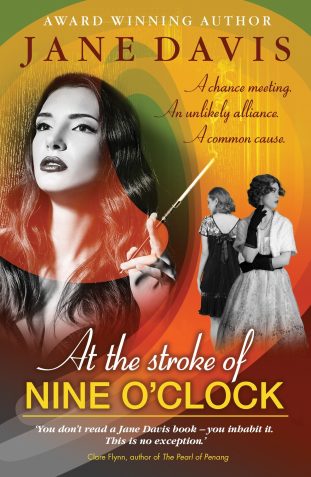
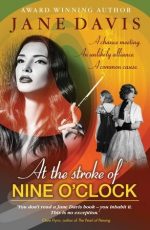
Or you may like to try At the Stroke of Nine O’Clock, which explores some of the issues Ruth faced while trying to survive on her wits in post-war London.
Click here to buy
Read a preview here
At the Stroke of Nine O’Clock
‘Before the reform of an archaic legal system, before second-wave feminism, before the #MeToo movement, the idea that the future is yours to make as a woman is an illusion.’ ~ Book Witch ⭐️ ⭐️ ⭐️ ⭐️ ⭐️
London, 1949: As the city rebuilds from the ashes of war, three women from vastly different backgrounds find themselves navigating a world dominated by men.
Like most working-class daughters, seventeen-year-old Caroline Wilby is expected to help support her family. Far from home and alone in a strange city, she must grab any opportunity that comes her way. And so she accepts a job as a hostess in a discreet gentleman’s club.
Star of the silver screen Ursula Delancy is no stranger to scandal, having left her husband and daughter to follow her lover to Hollywood. The affair almost destroyed her career. Now, desperate to reconnect with her estranged daughter, she has returned to London to appear on the West End stage. But while her performance garners rave reviews, a devastating revelation ensures that her private life dominates the headlines.
Patrice Hawtree was once the most photographed debutante of her generation. Childless and trapped in a loveless marriage, her plans to secure the future of her ancient family home are about to be jeopardised by her husband’s gambling addiction.
In a world that tries to dictate their choices, these women forge their own paths, finding unexpected strength in each other along the way. But when they unite to defend a young woman condemned for a crime of passion, they’ll be forced to confront their own deepest truths.
“Why do I feel an affinity with Ruth Ellis? I know how certain facts can be presented in such a way that there is no way to defend yourself. Not without hurting those you love.”
‘An extraordinary historical novel, so rich and detailed you emerge feeling as if you’ve just watched a classic film.’ ~ JJ Marsh, author
‘You don’t read a Jane Davis novel – you inhabit it. This is no exception.’ ~ Clare Flynn, author of The Pearl of Penang
‘This is the first time I have come across this author, and what a revelation! Jane Davis writes stunning prose that keeps the pages turning.’ ~ Historical Novel Society, Editor’s Choice
‘Another triumph from indie author Jane Davis in this gloriously gritty novel that engages head-on with a post-war London struggling to re-boot itself and wider society.’ ~ BurfoBookish
‘I didn’t so much read as consume this book.’ ~ Vivienne Tufnell, author
‘You are in the sure hands of a mistress of the written word.’ ~ Alison Morton, author
‘One of the best books I’ve read this year.’ ~ Denny
Press

Want to be featured?

Host a bookclub
Latest books







Read an excerpt

Author Member of The Alliance of Independent Authors
