
The Four 18th-Century Publishers and Booksellers Who Made Reading Affordable
How John Bell, Alexander Donaldson, James Lackington and others transformed the book trade and brought cheap literature to ordinary readers
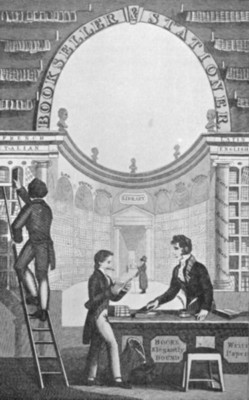
Today it is easy to forget that books were once luxury goods. A modern reader can buy a novel for a few pounds, download thousands of classics completely free, or borrow almost anything from a library. But in the early eighteenth century, owning a finely bound volume was a privilege reserved largely for the wealthy.
Yet during the eighteenth century, a quiet revolution took place in the British book trade. A group of innovative booksellers and publishers recognised that literacy rates were rising, igniting curiosity about literature. There was an opportunity to serve readers who had previously been excluded from the book market.
Among the most influential of these pioneers were John Bell, Alexander Donaldson, William and Cluer Dicey, and the publishers Cook and Harrison, all of whom paved the way for James and Dorcas Lackington. Through creative publishing formats, bold legal battles, and innovative marketing methods, they laid important foundations for the modern publishing industry based on the principle that books should be for the many, not for the few.
William and Cluer Dicey and the Eighteenth Century Chapbook
For ordinary readers, access to literature was extremely limited. Many rural communities relied on travelling peddlers who sold small pamphlets chapbooks, which were printed cheaply (but not so cheaply that they did not have wood-cut illustrations). Carried from village to village by travelling chapmen who had previously hawked ballads, they cost just a penny or two.
According to John Ashton, a collector of chapbooks, they contained “Religious, Diabolical, Supernatural, Superstitious, Romantic, Humorous, Legendary, Historical, Biographical, and Criminal, besides those which cannot fairly be put in any of the above categories.” In them we find the Joseph with his coat of many colours and Robin Hood, plenty to delight an eight-year old boy:
“I found he had very much turned his studies, for about twelve months past, into the lives and adventures of Don Bellianis of Greece, Guy of Warwick, The Seven Champions, and other historians of that age. . . . He would tell you the mismanagements of John Hickerthrift, find fault with the passionate temper in Bevis of Southampton and loved St. George for being Champion of England.” (Tatler, no. 95)
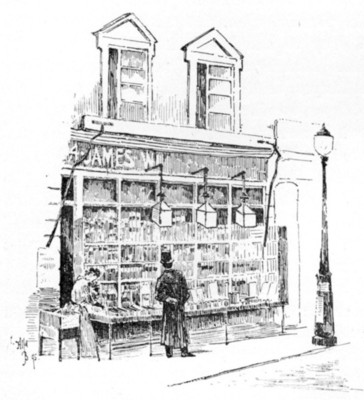
Writing in 1885, John Ashton noted that none of the chapbooks he had collected were dated after 1800, making them a peculiarly eighteenth-century phenomenon. He also tells us that nearly all of the original chapbooks came form a single source: William and Cluer Dicey, No. 4, Aldermary Churchyard (later Bow Churchyard). The popularity of these humble publications can be measured by the fact that each would be pirated soon after issue “especially at Newcastle, where certainly the next largest trade was done in this class of books,” but also in “Edinburgh, Glasgow, Paisley, Kilmarnock, Penrith, Stirling, Falkirk, Dublin, York, Stokesley, Warrington, Liverpool, Banbury, Aylesbury, Durham, Dumfries, Birmingham, Wolverhampton, Coventry, Whitehaven, Carlisle, Worcester, Cirencester,” showing just how wide the demand was.
Dicey’s chapbooks played an important role in spreading literacy and knowledge. Ashton tells us “…they flourished, for they formed nearly the sole literature of the poor, until the Penny Magazine and Chambers’s penny Tracts and Miscellanies gave them their deathblow, and relegated them to the book-shelves of collectors.”
John Bell and the Birth of the Pocket Classic
One of the first to challenge the traditional model was the London bookseller, John Bell.
Bell encountered readers who wanted access to important literary works but couldn’t afford the large editions typically produced by publishers. His solution was elegantly simple: publish classics in small, affordable pocket-sized volumes.
In the 1770s, Bell launched a number of influential series, including Bell’s British Poets, Bell’s British Theatre, and editions of Shakespeare. These works were printed in compact formats designed to be easily purchased, carried, and read.
Despite their smaller size, Bell’s editions weren’t crude. On the contrary, they were carefully printed and often illustrated by talented artists. They combined affordability with quality—something that had rarely been attempted before. (It sounds very much like the idea behind Penguin Books.)
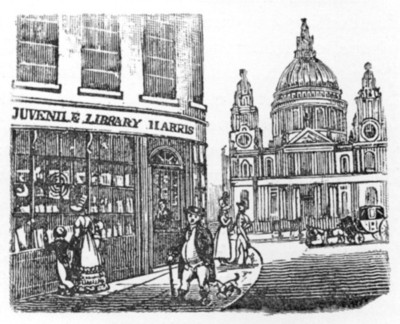
In A History of Booksellers, the Old and the New, Henry Curwen tells us that they “carried consternation into the trade, but scattered the English classics broadcast among the people.”
For the first time, many people could own portable editions of the English literary canon.
Bell should also be remembered for another small but significant modernisation of printed English. He abandoned the use of the long “s”, the old typographical character that resembled an “f” and had been common in English printing.
Cook and Harrison: The Rise of the “Numbers Trade”
Bell’s success quickly inspired competition.
Among his rivals were publishers Cook and Harrison, who expanded the idea of affordable literature through a clever marketing strategy known as the numbers trade.
Instead of selling expensive books as complete volumes, they divided them into weekly instalments—small sections that readers could buy cheaply. Each instalment, or “number,” cost only a small sum, allowing readers to build up a complete book over time.
For readers with limited income, this was transformative. Instead of saving for months to purchase a large volume, they could gradually collect a work piece by piece. (Interestingly, The Scotsman is currently publishing Alexander McCall Smith‘s latest novel 44 Scotland Street. The Prime of Bertie Pollock, a chapter at a time.)
The numbers trade proved especially effective for large works such as histories, encyclopaedias, and literary collections. It also encouraged readers to return regularly to booksellers, creating a steady relationship between publishers and customers.
Like Bell’s editions, these instalments were often printed in attractive small formats and decorated with engravings by skilled artists.
Together, these innovations helped demonstrate that literature could be produced for mass audiences without sacrificing quality.
Alexander Donaldson and the Battle Over Copyright
While Bell and his competitors revolutionised publishing formats, another bookseller was fighting a legal battle that would have an even greater impact on affordable books.
That man was Alexander Donaldson, an Edinburgh publisher who believed strongly in the idea of cheap reprints.
Donaldson realised that many famous works were no longer protected by copyright. If these works could be legally reprinted, they could be sold at much lower prices than the expensive editions produced by London publishers.
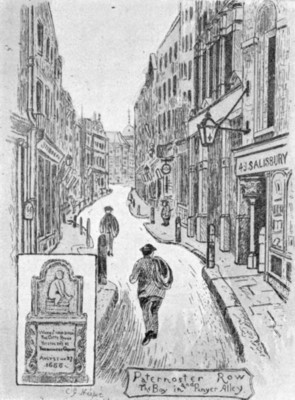
Paternoster Row, the heart of London’s Book Trade, Book-hunting in London, Public Domain
When Donaldson opened a bookshop on the Strand in London to sell such editions, he quickly attracted the hostility of the established trade, who believed they possessed perpetual rights to the works they had purchased from authors.
Samuel Johnson called him “a fellow who takes advantage of the state of the law to injure his brethren. And supposing he did reduce the price of books is no better than Robin Hood who robbed the rich to give to the poor.”
The dispute reached a crucial moment in 1771 when Donaldson reprinted James Thomson’s famous poem, The Seasons. London publishers sued him, claiming exclusive ownership of the work.
Donaldson’s defence was straightforward: the poem had first been published in 1729, and the author had died in 1748. According to existing law, the copyright term expired in 1757. But the matter was not straightforward and reached the House of Lords, which then ruled in Donaldson’s favour, confirming that copyright was not perpetual.
This marked a turning point in publishing history. It allowed works to enter the public domain after a certain period, making it possible for multiple publishers to produce inexpensive editions. Stationers were quick to fight back, and the term of copyright was later set at twenty-eight years, and has since been increased incrementally.
In the meanwhile, the result was clear: more books, at lower prices.

James Lackington: The Bookseller of the Masses
The stage was set for James and Dorcas Lackington to build one of the largest bookselling businesses of the late eighteenth century, culminating in the opening of the Temple of the Muses. Unlike many traditional booksellers, he embraced the idea of high volume and low prices.
His strategy was bold. Rather than selling books at high prices to a small number of wealthy customers, Lackington aimed to sell large quantities of books cheaply.
He attended book auctions regularly, sometimes spending staggering sums in a single afternoon to acquire stock. With this vast supply of books, he could reduce prices and attract a broader audience.
Lackington believed strongly that making books affordable would expand education and encourage reading among the general population. At the same time, he proved that such a model could also be profitable, adopting the motto, “Small Profits Do Great Things.”
In many ways, his approach anticipated modern retail strategies: lower margins, higher volume, and wider accessibility.
The Legacy of the 18th-Century Cheap Book Revolution
The impact of these pioneering booksellers still shapes our reading culture today. Modern paperback publishing, serialised novels, and the widespread availability of classic literature all owe something to the innovations of the eighteenth century.
What these men recognised—long before modern publishers—was a simple but powerful truth: The more affordable books become, the more people read.
And once reading spreads through a society, the effects can be profound.

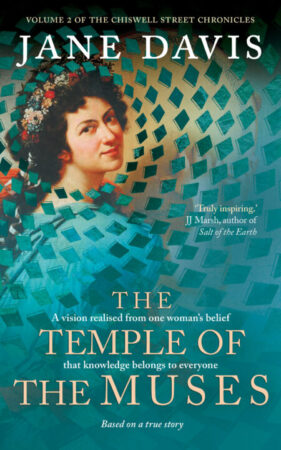
Part two of the Lackington’s story, The Temple of the Muses, is out now as an eBook with the paperback to follow on 2 April 2026.
If you have yet to read part, The Bookseller’s Wife, it is available for only 99p/99c until 15 March 2026.
Press
Want to be featured?

Host a bookclub

Latest books







Read an excerpt

Author Member of The Alliance of Independent Authors
