

When researching an entirely different story in the autumn of 2022, I visited the ancient church of St Mary the Virgin, Merton. Walking among the gravestones, one caught my eye:
Bookseller, Finsbury Square
Ladies who chance to frisk this way,
With honest Hearts and Spirits gay.
A serious moment give to one.
Who sleeps beneath this Earth & stone.
A better Daughter never liv’d.
A better Wife ne’er Husband griev’d.
To her the Claims of Kindred dear,
The tender Orphan would she rear.
Not e’re did to the Grave descend,
A more sincere or faithful Friend.
Think on her Virtues, heave a sigh,
That Goodness such as hers should die.
And whether you are Maid or Wife,
Go imitate her former life.
And when to Heaven you yield your Breath,
May you like her have Peace in Death.
Yet Dorcas Lackington should not only be remembered for her virtues. She is one of history’s hidden women – a participant in one of the most radical bookselling ventures of Georgian London.
Quiet Revolutionary Women
With historical research, it’s always easier to unearth information about a man than it is about a woman, and so I turned firstly to her husband. James Lackington left behind two memoirs, a wealth of catalogues, and public statements that allow historians to trace his life in unusual detail. Rising from poverty, he built a career on a revolutionary idea: that books should be sold cheaply and for cash, making reading accessible to ordinary people, as a tool of moral and intellectual advancement. His most famous achievement was the opening of The Temple of the Muses in Finsbury Square, a vast neo-classical book emporium that astonished his contemporaries and reshaped the culture of reading.

Dorcas, by contrast, left no letters, no signed documents, and no published words of her own. What we know of her must be pieced together from fleeting references, legal context, and comparison with other women in the book trade. This imbalance is not accidental. It reflects the legal and social structures of eighteenth-century England, in which married women’s identities were absorbed into those of their husbands under the doctrine of coverture. Dorcas didn’t vanish because she played a passive role in her husband’s business; she vanished because the law effectively rendered her invisible.
Many women in the book trade—printers’ wives, booksellers’ partners, binders, publishers, and retailers—remain difficult to trace. Unless they operated independently, usually as unmarried women, widows or if they were published authors, their contributions went undocumented. When women do appear clearly in the archive, it is often at moments of crisis: insolvency, death, or legal disputes.
This context helps explain why Dorcas’s gravestone speaks so warmly of her personal virtues, yet omits her professional life. The language of memorialisation reflected social ideals of womanhood rather than economic reality. Her work was folded into her husband’s name, just as her legal identity had been.
Not all of the details recorded by James Lackington in his memoirs can be corroborated by other sources. He may have recounted details as they were told to him, however, given his flair for story-telling, it is entirely possible that he invented parts of his own origin story to bolster his image as a self-made man. Nevertheless, his testimony remains invaluable, and where evidence is lacking, careful interpretation allows Dorcas to emerge as a figure of intelligence, agency, and quiet authority.

The years of his first marriage to Nancy were years in which James Lackington was struggling to establish himself in business. A practising Methodist, his stock was comprised of “improving” and mainly religious texts. He tells us in his memoirs that he would not stock books by “free-thinkers”, meaning those who rejected orthodox Christianity and questioned church authority.
From Bookshop to ‘Temple’: How Literacy Led to Empowerment
From 1775 onwards, we begin to see Dorcas’s influence at play. One of the clearest glimpses of her comes from The Forty-Five First Years, in which James Lackington records that his wife was an enthusiastic reader of novels and that it was she who introduced him to this form of literature. This was no trivial matter. Novels were still controversial in the late eighteenth century, frequently criticised as frivolous, morally suspect or downright dangerous, particularly for women, as these quotes show.
“Women, of every age, of every condition, contract and retain a taste for novels. The depravity is universal.” (Sylph no. 5, October 6, 1796: 36-37)
“Novels have been long and frequently regarded not as being merely useless to society, but even as pernicious, from the very indifferent morality, and ridiculous way of thinking, which they almost generally inculcate.” (Gentleman’s Magazine, 1789)
“If it be true that the present age is more corrupt than the preceding, the great multiplication of novels has probably contributed to its degeneracy.” (V Knox, 1788)
Before he tried them for himself, James may well have agreed with those sentiments. Afterwards he admitted that reading novels altered his outlook. As he broadened his reading, he expanded his stock to include novels alongside philosophy, history, poetry, and pamphlets reflecting a broad and democratic vision of reading. This shift proved instrumental to his commercial success.
James Lackington frequently travelled to buy stock, cultivate contacts, and promote his ideas. During these absences, the shop had to function. In his own words, Dorcas “delighted to be in the shop” and knew the stock so well that she could always lay her hands on what customers wanted. This suggests not an occasional presence, but deep familiarity with the business. This was important, not just in terms of “leaving the shop in a pair of safe hands” but the presence of a female bookseller.
How The Temple of the Muses Amplifies Women’s Voices in Cultural Life
Even in the late eighteenth century, it was not the done thing for genteel women to be seen in public, let alone in a bookseller’s shop. Print caricatures and satirical captions of the period satirised women readers, mocking them not simply for reading but for being seen to read in public. For example, prints like “Beauty in Search of Knowledge” depict women in circulating libraries as “pretty lispers”, relying on the stereotype that women lacked serious intellectual capacity.

In contrast to many of his contemporaries, James Lackington acknowledged female customers as essential to his success:
“The Ladies in particular have been very encouraging to me in my new method of selling books…” (Memoirs, 1791 ed., p. 235)
Further he rejects what the moralists of the day have to say about novels.
“I never could perceive that novels have done so much mischief as some grave gentlemen have imagined.” (Memoirs, 1791 ed., p. 233)
We may not see Dorcas’s name, but we can feel her steady influence. If we believe in education for all, that means women too. And Dorcas’s steadiness appears to have complemented James’s exuberance. Contemporary descriptions of James emphasise his energy, optimism, and flair for self-promotion. Dorcas, by contrast, emerges as a figure of judgement and balance, applying the formula she used to balance the household accounts to the business, essential to sustaining a business built on narrow profit margins and high turnover. Without her, the business would not have doubled its footprint in Chiswell-street and the Temple of the Muses might not have been built.
Its design, from its 140 foot frontage to its spacious light-filled shop floor, suggests that the Lackington’s brief to their architect included spaces that would be welcoming to women, including the “lounging rooms” reached by wide stairs, “intended merely for the accommodation of ladies and gentlemen, to whom the bustle of the ware-room may be an interruption.”
Visiting The Temple of the Muses would have been a very different experience to visiting one of London’s other bookshops – dark, low-ceilinged and looking like a gentleman’s study – where books were often stored on shelves behind counters, and those wishing to “browse” might have to pay a penny to read in the shop. Customers might read free in one of the lounging rooms while taking refreshments.
Dorcas Lackington died in January 1795, at a moment when the Temple of the Muses was emerging as one of London’s great landmarks, a must-see on any visitor’s list. She didn’t live to witness the ways in which Lackington’s model would influence bookselling for generations to come.
Already, early readers have shared with me their own reading journeys.
I was taught to read by my grandmother who lived with us when I was small, and books have been my constant friends all my life from age 4 until now when I am on the cusp of 80.
Patti
Isn’t that wonderful?
Dorcas’s story invites us to look beyond the named men of history and to recognise the quieter figures whose influence, though harder to trace, was no less profound. Standing by her grave in Merton, we are reminded that local history can illuminate national stories. Dorcas Lackington’s life connects what was then a rural parish churchyard to the bustling world of London’s eighteenth-century book trade, and her example challenges us to read written history more attentively, noticing not only who is recorded, but who is missing, and why.

Part 1 of Dorcas’s story, The Bookseller’s Wife, is available until 15th March for only 99p/99c.
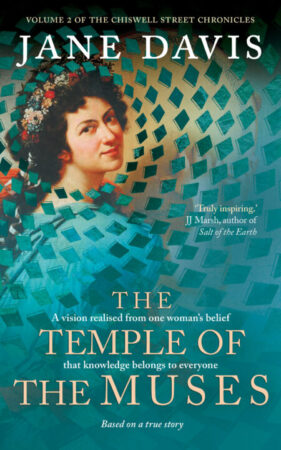
Buy The Temple of the Muses now.
Press
Want to be featured?

Host a bookclub
Latest books







Read an excerpt

Author Member of The Alliance of Independent Authors
