
When Bookselling was a Dangerous Business
The 18th Century crack-down on booksellers who sold political philosophy

In 1789, George III’s recovery from illness triggered nationwide celebrations that “exceeded every thing before known.” But were they really “grateful testimonies of a nation’s love”?
On 3rd April, the King issued a Royal Proclamation ordering that a day of thanksgiving be observed throughout the Kingdom to mark his recovery. Coupled with his first public appearance at St Paul’s Cathedral, this was a political act, demonstrating that he was fit to rule once again. Sermons and verses were written for the occasion. Bells rang out, elegant dinners were served and glasses and tankards were bumped as constitutional toasts were drunk. People paraded the streets and sang, “God save the King”.
Blest be the happy hour,
Thou didst our King restore,
Ever – for evermore,
Grateful we’ll sing,
God save the King.
By night, the skies over London lit up with fireworks extravagant displays and illuminations. Those on the Bank of England represented the City of London with the Sword of State and City Charter, and featured Britannia on a Triumphant Cart conducted by Hygiæa, Goddess of Health, Peace and Plenty.
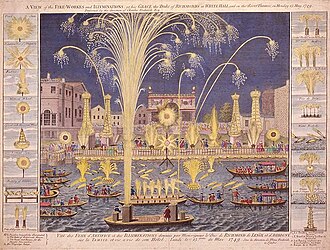
A view of the fireworks and illuminations at his Grace the Duke of Richmond’s at Whitehall, via Wikimedia Commons
The London Chronicle listed Lackington of Chiswell-street “first amongst the number of tradesmen who strove to excel in the brilliancy of their illuminations.” Never one to let a publicity opportunity pass him by, James Lackington excelled both as self-promotor and showman. Booksellers had good reason celebrate – at first. One of Mr Fox’s first acts in parliament was to repeal shop-tax.
While the British were celebrating their King, across the Channel, the French were rising up against the monarchy and demanding a new constitution based on the principles of freedom. A century earlier, the British had had its so-called “Glorious Revolution”. According to John Aitkin, the French people’s efforts were “regarded with general favour by the English nation, which could not but recognize the same rights in another people, that they had themselves so happily asserted.” In the early editions of his memoirs, James Lackington praised the French for having “caught the spark of freedom, and nobly emancipated themselves from a state of abject and degrading slavery, to a distinguished and honourable rank among nations.”
“A necessary and justified struggle against oppression”
The 18th Century gave birth to the London Corresponding Society, founded with the purpose of political debate and the circulation of ideas in print. One such work was Rights of Man, in which its author Thomas Paine argued that “Rights are inherently in all the inhabitants; but charters, by annulling those rights, in the majority, leave the right, by exclusion, in the hands of a few.”
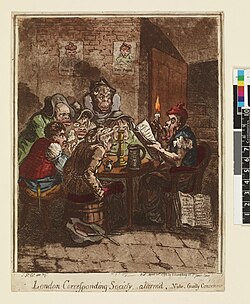
London Corresponding Society alarm’d, Print made by: James Gillray via Wikimedia Commons
This fighting talk echoed an earlier work by John Jebb, which stated that it was the right of the people to “punish with exemplary rigour every person, with whom they have entrusted power, provided in their opinion, he shall be found to have betrayed that trust.”
Concerned about the controversy it would cause, Joseph Johnson famously backed out of publishing Rights of Man. Jeremiah Samuel Jordan and Henry Delahay Symonds stepped into the fray. Printed cheaply and sold for just a few shillings, it became a runaway success. And in an era when people read aloud in coffee-houses, taverns and at home, each of the 200,000 copies sold reached dozens of listeners. James Lackington wrote that, according to his best estimate, more than four times the number of books were sold in the year 1791 than in the twenty years before. Lackington’s certainly saw its share, with sales reaching 100,000 books a year, and profits of £4000. These days we might call it “the Rights of Man effect.” But Johnson was right to have exercised caution. Not everyone was happy to see books containing ideas about the rights of individuals in the hands of working people. There was a growing fear among the British ruling class that the revolutionary spirit would spread to London.
Paine in the firing line
On 21 May 1792, George III issued a Royal Proclamation Against Seditious Writings and Publications. It may not have only been aimed at Paine, but Paine responded with Letter Addressed to the Addressers on the Late Proclamation and, in doing so, stepped into the firing line. Charged with seditious libel, Paine fled to France.
In his absence, he was convicted, as were his publishers. While Symonds was serving a two-year sentence, he and the publisher James Ridgway were convicted for their part in printing and circulating Thomas Paine’s Letter Addressed to the Addressers.
A crack-down on booksellers
Fearful that Enlightenment ideas would radicalise a generation of young impressionable minds, the government instigated a crack-down, targeting booksellers who were distributing Rights of Man and other philosophic works. Arguably, putting a book containing such ideas in a reader’s hands had always been a political act. Now, it was a crime.
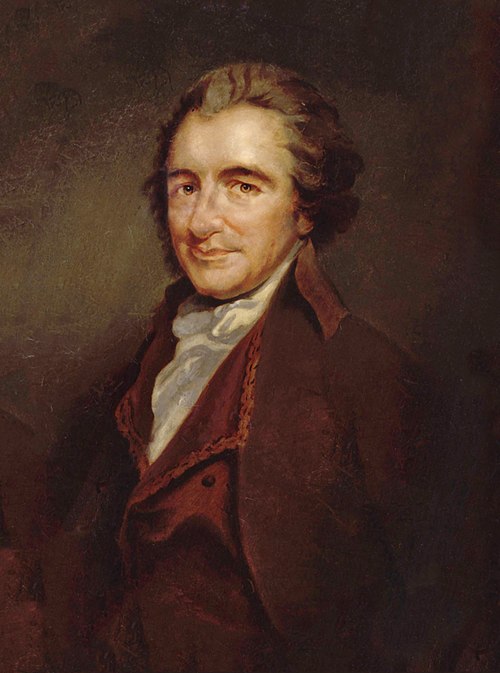
Thomas Paine, copy by Auguste Millière, after an engraving by William Sharp, after George Romney, circa 1876 (1792) via Wikimedia Commons
Leicester bookseller Richard Phillips (later knighted) was entrapped by a government agent who bought Rights of Man from his shop, then used it as evidence to prosecute him. Despite swearing an affidavit that he wasn’t aware the publication was libellous, Phillips was sentenced to eighteen months in prison.
These would have been a testing time for any bookseller. But Lackington wasn’t only stocking such works. He boasted that J Lackington and Company were the cheapest booksellers in the world. Then there was the embarrassment of his memoirs. In 1792, Lackington published a new edition, one hundred pages longer than the first, as he had “omitted to introduce many things which would have been an improvement to the work.” There is an alternative explanation. With government agents targeting booksellers, he deleted any reference to support for the French revolutionaries.
The government crack-down only increased circulation of Rights of Man, with pirated copies and cheap foreign editions being smuggled into Britain through the ports.
A real-time debate, shaped by the print industry
The government propaganda machinery was well-oiled. Magistrate John Reeves founded the Association for Preserving Liberty and Property against Republicans and Levellers. Its aim was to preserve the monarchy, the Church of England, and existing social order. They, too, printed and distributed thousands of pamphlets, maintaining that the British constitution was already balanced and free, and that radical reform risked anarchy, mob rule and a repeat of revolutionary violence.
On 28 November 1792, the attorney general issued bills of indictment for libel against seven publishers and printers, including John Ridgway and Daniel Holt. Sentenced to four years in prison and heavily fined, they became subjects of public sympathy.
“Louis must die so that the nation may live”
In 1791, William Blake had penned his poem, The French Revolution:
“Ancient wonders frown over the kingdom, and cries of women and babes are heard,
And tempests of doubt roll around me, and fierce sorrows, because of the nobles of France.
Depart! answer not! for the tempest must fall, as in years that are passed away.”
Doubt turned to shock when news confirmed that the Republic of France had tried Louis XVI for treason and found him guilty. Now the question of a fitting punishment arose. Despite fears that execution would make Louis a martyr, or provoke war with other monarchies, those in favour of the death penalty won by the narrowest of margins. Shockingly, Louis XVI’s cousin, Philippe Égalité was among those who voted for the death penalty, demonstrating how old loyalties had been turned on their heads. Perhaps Philippe feared for his own.
On Sunday 21 January 1793, the King was taken to the Place de la Révolution (now the Place de la Concorde), where he was to be executed by guillotine. Accounts describe him attempting to address the large crowd that had gathered, asserting his innocence and forgiving his enemies. His words were drowned out by drums.
In England, even those who had rejoiced at the storming of the Bastille reacted with shock. The government showed its protest by expelling the French Ambassador from London. The French saw this as an insult, and in February 1793 they declared war. Britannica reciprocated.
During wartime, the British government reclassified Paine’s arguments. They no longer viewed them as merely seditious. Authorities seized pamphlets, handbills and cheap editions of radical publications which were said to be “evidence of treason”.
Demands for political reform
In April 1793, the London Corresponding Society advertised a petition demanding political reform, printing the names of contacts and addresses where the people could add their names. These including Mr Ridgeway, bookseller, York-street, St James’s Square, Mr Hardy, No. 9 Piccadilly, Mr Lambath, No. 3, St George’s Mall, Mr Eaton, bookseller, No. 81 Bishopsgate Without, Mr Spence, bookseller, No. 8 Little Turnstile, Holborn.
![Pitt as hangman stands beside a fire of faggots immediately outside the door of the 'Crown & Anchor' (name on door-post). In his right hand is an axe; he drops an open book into the flames, and looks over his shoulder at Reeves who is disappearing into the tavern. On one page (right) is the trunk of a tree surmounted by a crown and the words 'The Royal Stump', on the other: 'No Lords No Commons No Parliame[nt] Damn the Revolution'. He wears a long coat with a hangman's noose tied round his waist, a round hat, and wrinkled gaiters. From his pocket protrudes a book: 'Ministerial Sincerity and Attachment a Novel'. He says:
"Know, villains, when such paltry slaves presume
To mix in Treason, if the plot succeeds,
You're thrown neglected by: - but if it fails,
You're sure to die like dogs!"](https://jane-davis.co.uk/wp-content/uploads/2026/04/330px-The_Crown__Anchor_libel_burnt_by_the_public_hangman-_BM_18680808.6484.jpg)
The print trade as part of a potential insurrection
By today’s standards, the demands seem mild – universal male suffrage, annual parliaments and fairer representation, with the people having a right to choose their representatives. Thomas Hardy, founder of the London Corresponding Society, co-founder John Thelwall, and John Horne Tooke were accused of plotting to overthrow the monarchy and the constitution. Their trial was a public spectacle. Ordinary readers who were called to testify said that they bought Rights of Man out of curiosity and saw it not as an instruction manual, but something for discussion. Ultimately, the accused were acquitted, and accounts of the trials were published and read widely.
Perhaps Dorcas urged her husband to be cautious as he published his catalogues in 1793 and 1794. This was a time to advertise that Lackington’s was selling novels, history and voyages, not radical philosophy.
Ideas were impossible to contain
In December 1795, Pitt’s government enacted two repressive laws: The Seditious Meetings Act and the Treasonable Practices Act. Both aimed to suppress dissent and limit public assembly during a period of perceived revolutionary threat.
By the time booksellers were no longer in the spotlight, some had been put out of business. And the prosecutions did not end there. Radical publishers continued to be hounded.
Dorcas died in 1795, but perhaps the upheavals and the need to constantly look over his shoulder hastened James’s decision to retire three years later.
The Temple of the Muses continued, with George Lackington and Robert (Robin) Allen at the helm. In the new century, Percy Shelley would write from Oxford University to enquire about radical books the university library refused to stock.
Still relevant today
If you think state censorship is ancient history, think again.
In Hong Kong this week, as part of an ongoing campaign, police arrested five booksellers on suspicion of selling “seditious” publications under Hong Kong’s national security legislation.
In India this week, authorities in Jammu and Kashmir arrested three publishers over books alleged to “glorify separatist leaders”.
Since the invasion of Ukraine, Russian authorities have prosecuted publishers and booksellers for works relating to LGBTQ+ issues, criticism of the war, or authors designated as “foreign agents.”
In Belarus, independent publishers and book distributors continue to face raids, confiscations, and criminal cases tied to opposition literature and Belarusian-language publishing.
In China (mainland), publishing remains tightly controlled through licensing and censorship, but there has also been increased enforcement against private distributors and online sellers of politically-sensitive works.
In democratic systems, disputes are usually fought through school curricula, library policies, or court challenges, providing opportunities for public debate. Elsewhere, national security is increasingly given as the reason given for crackdown operations. And with fixed premises and subject to business licences, booksellers, printers, and publishers are far easier to target than authors. Bookselling is still a dangerous business to be in.

To have future posts delivered directly to your in-box, visit the sidebar on the right and subscribe to my blog, or to find out about new releases, competitions and freebies, subscribe to my newsletter and I will send you a free copy of my novel, I Stopped Time, as a personal thank you.
While I have your attention, can I please draw your attention to my updated Privacy Policy. (You may have noticed, they’re all the rage.) I hope this will reassure you that I take your privacy seriously.
Remember, if you enjoyed this post please share it.
Press
Want to be featured?

Host a bookclub
Latest books







Read an excerpt

Author Member of The Alliance of Independent Authors
