

In the bustling heart of Georgian London, James and Dorcas Lackington didn’t just open a bookshop—they created a cultural landmark.
As their business outgrew its Chiswell Street premises, the Lackingtons dared to think bigger: a temple to books. Situated on one side of Finsbury Square (32 Finsbury Place South) and designed by architect George Dance, the shop boasted a frontage 140 feet wide and was described as “the most extraordinary library in the world.” It quickly became one of London’s must-see attractions.
At the center of the shop floor, beneath a grand glass dome, was an immense circular counter with enough space to drive a coach and four horses around it, as Lackington himself demonstrated at the opening. The shop’s stock of half a million volumes was displayed in a series of circular galleries, connected by a broad staircase that led to the “lounging rooms”—spaces where ladies and gentlemen could escape the bustle, relax, and read a book. These rooms became fashionable meeting places, offering a public forum for the city’s growing reading audience.
Why “The Temple of the Muses”?
Following the excavation of Herculaneum in 1738 and Pompei in 1748, Londoners developed an insatiable appetite for antiquities.
Naples, Pompeii, and Herculaneum became important destinations on the European Grand Tour, a rite of passage for aristocratic young men, and for the wealthy on their honeymoons.
They might have been welcomed at the Naples home of the British ambassador, Sir William Hamilton, who was ideally placed to pursue his passion for collecting antiquities. In 1772, he sold his entire collection to the British Museum but before shipping the collection, Hamilton arranged for Pierre-Francois Hugues d’Hancarville to oversee the cataloguing and drawing of every object, a project which resulted in the publication of A Collection of Etruscan, Greek, and Roman Antiquities from the Cabinet of the Honourable William Hamilton. Its hand-coloured engraved plates circulated classical motifs across Europe, giving architects, artists and designers examples of material to work from.
The architects James and Robert Adams incorporated classical motifs in their interiors and English manufacturer Josiah Wedgwood was quick to satisfy the growing demand, by mass-producing artefacts based upon wall-paintings and stucco relief work from Pompeii, Herculaneum and Rome. Wedgwood’s neoclassical jasperware and black basalt ceramics became iconic examples of the aesthetic.

Visitors to the British ambassador’s Naples home might have been treated to what became became one of the most talked-about cultural phenomena of the late Grand Tour era, Lady Hamilton’s famous “attitudes”. Emma Hamilton’s face was one the London elite knew well from George Romney’s paintings of her. She appeared in over sixty of his portraits. Romney recognised her ability to embody classical nymphs, muses and figures from poetry and myth.
Joshua Reynolds also painted her, and as President of the Royal Academy his portraits carried cultural weight and cemented Emma’s fame as a celebrated beauty. Her attitudes built on her experience as an artist’s model. Part classical revival, part theatre, part living sculpture, they moved through a sequence of poses inspired by ancient sculpture, vase paintings, and famous artworks, using facial expression, posture, and gestures. The poet Goethe (who saw her in 1787) wrote enthusiastically about how she moved from pose to pose like figures from antiquity and Renaissance painting. Other observers said that it was like seeing ancient statues come to life.
By the mid-late 18th century there was a growing trend for British women on the Grand Tour to have their portraits painted as muses. Angelica Kauffman painted Emma Hamilton as the comic Muse, Thalia, Lady Elizabeth Percy as Minerva, the Roman goddess of wisdom and the arts and Lady Charlotte Finch in flowing antique-style dress inspired by sculpture.

Emma Hamilton as Circe by George Romney, Wikimedia Commons
Perhaps influenced by Emma’s attitudes, the 11th Earl of Buchan, a famous eccentric and founder of the Society of Antiquaries of Scotland, created a tableau for assembled guests in his Edinburgh drawing room. Nine ladies ‘of the first rank’ were dressed as the muses, and Buchan took the part of Apollo. All he needed was a Cupid, a ‘blooming boy of ten or twelve’ who made a dramatic entrance, naked except for his bow and quiver. Later the earl built his very own Temple of the Muses on his Dryburgh estate.
More than Marketing Savvy
In 1780 James Graham opened his Temple of Health, a health and fertility spa that owed as much to spectacle and performance as it did to medicine. A master of self-promotion, James Lackington would have been aware that Graham’s establishment quickly became the talk of fashionable London, depicted in satirical plays, poems, prints and newspaper skits, all of which oiled the cogs of the publicity machine.
Lackington actively sought publicity. By commissioning a neo-classical design and positioning the shop as a shrine to reading and knowledge, he was evoking the sacred spaces of learning and inspiration revered since antiquity. But he was also capitalising on a trend.
Women, Knowledge, and the Modern Muses
For Dorcas Lackington, the name would have resonated on another level.
Perhaps it would have brought to mind Mary Chudleigh’s 1710 Essays upon Several Subjects of Knowledge, To the Ladies, which celebrated female intellectual achievement:
“When ancient Greece was for her Arts renown’d,
Was for her Learning and her Honour crown’d;
The Men alone did not the Glory share,
The Muses had their Female Votaries there…”
Chudleigh argued that women had historically been active participants in knowledge and urged contemporary women not to be shut out of learning—a sentiment echoing Enlightenment debates about reason, education, and gender.
This idea found visual expression in Richard Samuel’s 1778 painting, Portraits in the Characters of the Muses in the Temple of Apollo. In classical mythology, the Nine Muses are female divinities who preside over poetry, history, music, astronomy, and learning. They inspired rather than created. But Samuel depicted nine prominent British women—writers, artists, historians, and performers linked to the Bluestocking Circle—as the Muses, asserting their legitimacy as men’s intellectual equals and active producers of culture, aligning their achievements with national pride and public visibility.

From Myth to Marketplace
By naming his bookshop The Temple of the Muses, the Lackingtons linked their enterprise to centuries of cultural ideals—from classical sanctuaries to Renaissance art to Enlightenment debates about education—creating a space that was not merely a shop, but a temple to learning.
As for Dorcas…
In mythology, the Muses are female divinities who inspired men to create. When Dorcas married James Lackington, her property became his. As a woman, although an active participant in the business, she knew that as far as the world was concerned, Lackington’s was very much her husband’s enterprise. But Dorcas was no mere helpmeet. That is why her story deserves to be told.
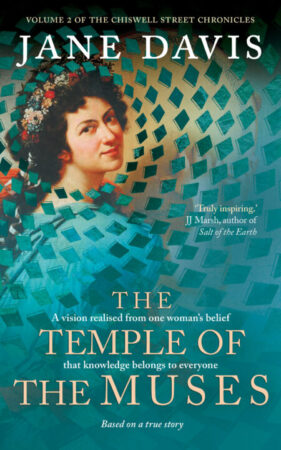
The Temple of the Muses will be released in ebook on 2 March 2026 and in paperback on 2 April 2026. Available for pre-order now!

Press
Want to be featured?

Host a bookclub
Latest books









Read an excerpt
Author Member of The Alliance of Independent Authors
