

Today, we take it for granted that books are within our grasp, but it wasn’t always so.
By the late 18th century, literacy in England was steadily improving. Based on the ability to write their signature at the time of their marriages, historians estimate that approximately half of the population could read. But owning a book? That was a luxury few could afford.
In Georgian England, books were expensive to produce. Printing costs were high, paper was costly, and many books were sold in fine bindings aimed at wealthy buyers. Most booksellers worked on credit, selling to established customers who could afford large purchases. Browsing was limited, with stock kept behind counters, and shops often catered to scholars, clergy, and the upper classes.
For others, access to books was limited. Less well-off families tended to live close to subsistence level, and purchasing a book that cost a week’s income simply wouldn’t have been high on their list of priorities. Even joining a circulating library would have been beyond their means. The key to ordinary people’s reading habits was cheap print. Pamphlets, chapbooks, broadsides (single-sheet news and stories), play scripts and ballads were sold in markets, bookshops, and even on street corners, some costing just a penny or two. Often, they were shared among families and neighbours, and in taverns, coffee houses, and places of work.
But the idea that ordinary people — apprentices, servants, labourers — might buy books was considered radical, even dangerous. Yet it was precisely this belief that helped reshape society, spread new ideas, and quietly fuel social change.

Why Knowledge Was Seen as Dangerous
Affordable books weren’t just resisted for economic reasons. Many in power believed that education and reading could make the lower classes restless as they imagined a world beyond the constraints imposed on them.
This fear was not without foundation. Enlightenment thinkers such as John Locke, Jean-Jacques Rousseau, and Voltaire were questioning monarchy, religion, and what was seen as “the natural order” of society. Across the Atlantic, the American colonies had recently broken free from British rule, and across the Channel, tensions were building that would erupt into the French Revolution.
Books were the main vehicles for ideas about liberty, equality, and individual rights. Keeping them expensive was a way of safely containing knowledge and power.

A New Vision for Bookselling
Into this world stepped James and Dorcas Lackington, two innovative booksellers who believed reading should be accessible to everyone.
Rather than selling on credit at high prices, they experimented with cheap editions and cash-only sales, combined with large volumes of stock – stock that might otherwise have been pulped.
“Say we were to advertise that Lackington’s deals only in cash. Combined with a pledge that our lowest price will be marked on every book, I believe it would be welcomed as a novelty.”
To look for a comparison, we have to look to the advent of eBooks, or The Reading Agency’s Quick Reads initiative. Backed by Stormzy, it targets “non-readers, lapsed readers, people with short attention spans, and neurodivergent readers” – anyone, in fact, who has thought that reading was not for them – offering them a short digestible book for just £1.00.
By lowering profit margins but increasing sales numbers, the Lackingtons made books affordable to people who had never been able to buy them before. Many ordinary people encountered philosophies of liberty, equality, and justice for the first time. They began to think critically about the world around them.
A Bold Challenge to Tradition
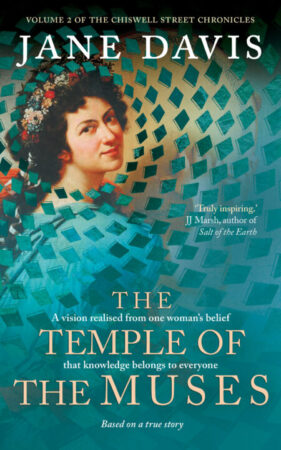
The Lackington’s bold strategy wouldn’t have been popular with the authorities. And as a tireless self-promoter, James Lackington made himself a target. In his memoirs, he wrote about those who tried to destroy him, as well as exposing the very practices that kept books expensive. He would have made powerful enemies among the bookselling fraternity and beyond, a scenario I explore in The Temple of the Muses. Printers and booksellers risked fines, imprisonment, or worse if they distributed material deemed seditious or immoral – and there is no doubt that Lackington’s sold books that could have been seen in that light. We know that is where Percy Shelley sourced books that were banned at Oxford University.

In this cartoon, the artist tried to make it look as if James Lackington himself was on trial. He was clearly so well-known by 1794 that it was not even necessary to name him.
How Affordable Books Changed Lives
By the time the Lackingtons opened The Temple of the Muses, they confidently hung a sign over the door that proclaimed: Cheapest Bookstore in the World.
The impact was enormous.
With access to books, people gained education beyond the school-room, exposure to new ideas and cultures, inspiration for self-improvement and – perhaps more importantly – a sense of independence and possibility. Books became tools of empowerment, offering not just entertainment, but hope.
For women — often excluded from formal education — books opened doors to knowledge and self-expression. Affordable books helped fuel the rise of female readers, writers, and thinkers.
The radical idea of affordable books laid the foundation for the reading world we know today, leading to mass-market publishing, public libraries and widespread literacy.
What once seemed dangerous became essential. The belief that everyone deserves access to knowledge is now a cornerstone of modern society.
Why This Revolution Still Matters
It’s easy to forget how hard-won access to books once was. The fight to make books affordable wasn’t just about commerce — it was about equality.
The fight continued well into the 20th century. When Allen Lane founded Penguin in 1935, he wanted to make high-quality literature affordable and widely accessible. At the time, most books were expensive hardbacks. Lane set out to prove that serious literature could be sold in paperback, and deliberately set the price at sixpence, about the same as a packet of cigarettes.
Now, it seems that the end is in sight for mass-market paperbacks, we may well see the cost of reading increase.
“You could be anybody of any kind of background. And for basically the equivalent of a dollar or two, you know, you could be educated.” ~ publisher Esther Margolis
Even now, in a world of free libraries and digital books, reading remains an act of freedom. People continue to fight for access to education, defend banned books, and use literature as a tool to challenge injustice.
The Temple of the Muses will be released in ebook on 2 March 2026 and in paperback on 2 April 2026. Available for pre-order now!

Press
Want to be featured?

Host a bookclub
Latest books







Read an excerpt
Author Member of The Alliance of Independent Authors
