

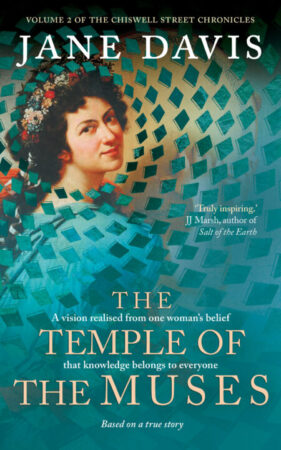
Imagine stepping inside The Temple of the Muses in Finsbury Square — the bookshop famed in Georgian London as the largest in Europe. Shelves teem with novels, histories, pamphlets and curiosities. Priceless tomes sit side by side with cheap editions. Amid the bustle, male shop assistants in black frock-coats stand behind the circular counter underneath the dome.
Stop right there.
Most stories of the Georgian book trade are told through the surviving voices of men. But, as historians remind us, women played a crucial role in print culture: as papermakers, copperplate makers, printers, publishers, binders and booksellers.
Dorcas Lackington: Avid Reader of Novels
One such woman is Dorcas Lackington, wife of the bookseller James Lackington — a man whose memoirs and catalogues document how he made a fortune by selling books at the lowest possible price while still making a profit. In contrast, Dorcas’s own voice is silent. None of her letters have survived. There are no mentions in third-party correspondence, no letters addressed to “Mrs Lackington”.
But we do catch a glimpse of her in her husband’s memoirs. He tells us that Dorcas was an avid reader of novels and “her extreme love for books made her delight to be in the shop… and could readily get any article that was asked for,” ensuring that “the business was in safe hands” when James was away on book-buying trips.
Their partnership was not only personal but commercial. Her careful oversight, her welcoming of customers, and her familiarity with the stock of books were not uncommon roles for women of the book trade — but they rarely generated the archival footprint that historians rely on. That is part of what made her so intriguing, and why I chose her for the subject of The Bookseller’s Wife and The Temple of the Muses.

Why Dorcas Disappeared from the Archive: What Women Lost on Entering Wedlock
In 18th century England, marriage brought about a profound legal transformation for women — one that explains why so many simply vanish from the record.
Under the doctrine of coverture, a married woman ceased to exist as a separate legal person: her identity was absorbed into that of her husband. She could no longer own property in her own name, enter into contracts, sue or be sued, or control her earnings. In the eyes of the law, she wasn’t Dorcas Lackington, but Mrs James Lackington. This legal erasure had archival consequences. For women working inside family firms, marriage didn’t remove them from economic life, but it removed their right to be named within it. What looks like silence in the archives is therefore not passivity, but merely the legal condition of being a wife.
When Women Do Appear in the Archive
Spinsters
We can compare Dorcas’s silence with the records left by unmarried Martha Gurney (1733-1816), who supported herself as a bookseller between 1770 – 1813, trading from Bell-yard Temple and later from 128 Holborn Hill. Her name appeared on over 100 publications. Between 1791 and 1794 she collaborated with William Fox on 16 highly charged anti-slavery pamphlets. Today Martha is recognised as the only woman who published and sold anti-slavery tracts and one of the very few to have had a significant impact on the issue.
Very occasionally married women in the London book trade do appear in records — usually when they held legal or commercial authority in their own name.

Published authors
Women such as Lucy Peacock, one of the first stars of Children’s literature and a translator of several works from French into English. Her husband R. Peacock (fl. 1792-1807) ran a bookshop and went on to found the Juvenile Library on Oxford Street. By 1792, Lucy had published four works of fiction. By 1805, she was operating the library by herself, while her husband and son ran a shop in Chancery Lane. But even she is not always readily identifiable as a woman, because her name appears as both ‘L Peacock’ and ‘Mrs Peacock’ on imprints.
The majority of women in the trade only become visible when they step outside their husband’s legal shadow.
Widows
“Rebecca Edwards, widow of William Edwards, late stationer in the Temple-Cloisters, begs leave to inform the friends and customers of her late husband… that she intends to carry on the stationery business in all its branches.”
— Daily Advertiser, 1 January 1776
Under English common law, a widow became a feme sole (a woman legally independent). This came with the right to continue their late husband’s trade, open shops, stalls, or workshops, become members of guilds or livery companies (often as widows of freemen), employ apprentices and servants, pay taxes and hold business licenses.
We see many examples of widows who thrived at the helm of businesses.
For many years Mary Lewis (1703-91) worked alongside her husband John in their printing and bookselling establishment at the Bible and Dove, 1 Paternoster Row. After her husband’s death in 1755, Mary becomes visible in the archives. She transformed the business from a narrowly focussed religious print shop to a vibrant publishing enterprise. Her name appeared on 338 imprints.
After her husband’s death, Mary Cooper continued his printing and bookselling business on Paternoster Row under her own name. Her name appears on a wealth of title pages and imprints. She is recognised as the earliest publisher of children’s books, including the first known collection of English nursery rhymes in print (1744) although she also published an erotic novel. Besides being a trade publisher she owned the copyright to more than 18 titles and is also credited with publishing a newspaper, the Manchester Vindicated.
These women became visible after their husbands’ deaths, not because they achieved greater success, but because the law permitted them to be seen. But social expectations encouraged remarriage, which would end their legal independence.
Take Mary Bryan who assumed control of her husband’s business after he died insolvent in 1814. She had to work to pay off his debts and support their six children. Mary published 24 books written by others. She also found time to write, publishing a book of poems Sonnets and Metrical Tales, praised by Walter Scott for their clarity, grace, and adherence to traditional form. Mary remarried in 1820, but this is not the last we hear of her. She turned novelist and published her novel Longhollow: a Country Tale under her married name, Mrs Bryan Bedingfield. The difficulty is knowing that Mary Bryan and Mrs Bryan Bedingfield are one and the same person.

And difficulties in identifying women in the trade do not end there.
Elizabeth Cox assumed control of her husband’s publishing and bookselling business when she was widowed, assisted in by her son. Her name appears on their imprints as ‘E. Cox and Son’ or simply ‘E Cox.’
Elizabeth Omer Delahoy took control of the Albion Printing Office after her husband died and published under the business name, ‘Albion Press’.
Even Martha Gurney appeared as ‘M Gurney’ on over 100 publications, and as ‘Martha Gurney’ on only two.
If we search the trade directories for booksellers identified only by an initial and a surname, doesn’t it stand to reason that we will find more women?
Advertisements and Public Notices
Trade advertisements are treasure troves for voices otherwise lost. Here are two examples of how women asserted their presence in the marketplace:
“Mrs. Elizabeth Cox, Stationer, has just published…”
“Lowe, Mrs. At No. 22, Pall-Mall, nearly opposite Carlton House, Mrs. Lowes has opened an extensive Circulating Library (Times 22 Nov 1794). At No. 22, Pall-Mall, opposite Carlton House, Mrs. Lowes, bookseller to her Majesty, has opened an extensive Circulating Library.” (Times, 3 Feb 1796).
Apprenticeships: Girls at the Threshold of the Trade
One of the clearest ways women surface in records is not as wives or widows, but as apprentices — girls bound into the trade before marriage erased their legal identity.
Although historians estimate that only 1% of apprentices in the book trade were female, records of the Stationers’ Company show that they might be stationers, bookbinders, printers, papermakers, and pen-cutters. Names such as Hannah Clarke, Elizabeth Barefoot, Lucy Batson and Anne Richardson appear with premiums carefully recorded — £5, £15, £50 — alongside the names of their masters, and sometimes mistresses.
Women such as Margaret Bland and Susanna Capon appear first as apprentices and later as book trade masters, taking on apprentices in their turn.
That said, the irony is striking: the archive remembers women most clearly before marriage but forgets them when they became central to a family businesses.
Runaway Apprentices: Girls Who Rejected the Trade
Young people were bound tightly — legally, and economically — and not all stayed the course. Masters in the book and print trades regularly advertised for runaway apprentices, leaving behind some of the most vivid records of working life.
“Whereas Sarah Elizabeth Sophia Stevens, apprentice to Henry Chapman, bookseller, Old Round Court, in the parish of St. Martin in the Fields, hath run away from her said master…”
— Daily Advertiser, 24 January 1785
Masters often included identifying details to aid identification:
“She is of a slender make, about fifteen years of age, wore a dark cloak and plain cap, and may endeavour to pass as a servant.”
Any many ended with a stark warning:
“All persons are hereby cautioned against harbouring or employing her, as they will be prosecuted to the utmost rigour of the law.”
This underscores how vigorously contracts were enforced — and how little room young women had to renegotiate their futures once bound.

Fleeting Visibility
Sometimes we catch a glimpse of women in the trade from newspaper records at moments of triumph, misfortune, or at their demise.
“Muller, Mrs. [Wants place ] As upper maid, a steady young woman … Direct for A.B. at Mrs. Muller’s Circulating Library, No. 34, Swallow-street, Piccadilly.” (Times 11 Aug 1796)
“Applebee, Mrs. On Saturday morning [3 Mar] the house of Mrs. Applebee, printer, in Bolt-court, Fleet-street was broke open …”
— Daily Advertiser 5 Mar 1750
“Arthur, Susannah. Susannah Arthur, late of the Strand, since of Porter-street, Newport-market, pocketbook maker, insolvent debtor and prisoner in H.M. Prison of the Fleet”
— London Gazette 19 Aug 1797
“Long, Mary. On Monday last [22 Jan] died at her house in Portland-street, Soho, Mrs. Mary Long, bookseller”
— Daily Advertiser 27 Jan 1776
Here the language is unemotional and official — but it confirms that women were legally accountable, financially independent enough to fail, and treated as full economic actors.
Court-adjacent records and legal sale notices preserve Elizabeth Reeve’s professional identity at the moment of reckoning:
“To be sold by auction… all the Printing Materials of the late Mrs. Elizabeth Reeve; amongst which are several fonts… and a printing press.”
— Daily Advertiser, 24 February 1773
This is effectively a post-mortem inventory, but it speaks volumes. Elizabeth owned presses, she controlled type and her trade identity survived her death.
For fiction readers, this is a perfect reminder that women’s working lives often surface only at moments of loss, debt, or death.
For Lovers of Historical Fiction
If you’re captivated by the daily hum of Georgian London — the noise of foot traffic across cobblestones, the scent of fresh ink and leather-bound volumes — then think of Dorcas as a quiet hero of that world.
She may not leave behind letters or title pages with her name emblazoned across them, but she was part of the pulse of the trade, helping to reach new audiences for books, and spreading her love of literature – and especially novels.

Publication
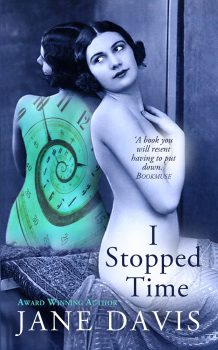
The Bookseller’s Wife is on sale until 15 March 2026 at 99c/99p
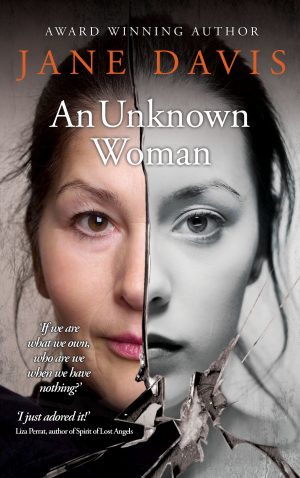
The Temple of the Muses will be released on 2 March 2026 (eBook) and 2 April 2026 (paperback).
Press
Want to be featured?

Host a bookclub
Latest books







Read an excerpt

Author Member of The Alliance of Independent Authors
