
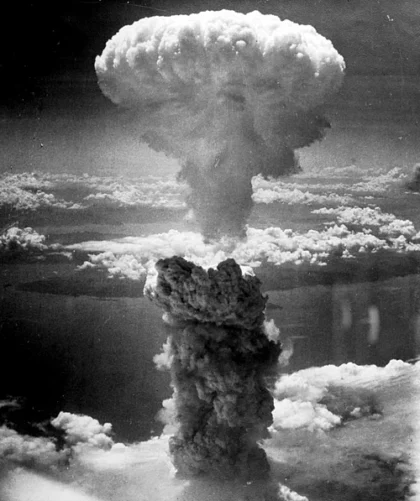
The main protagonist in my novel, My Counterfeit Self, is Lucy Forrester, a political poet and activist. Having been anti-establishment all of her life, she’s horrified to find that she’s been featured on the New Year’s Honours list. Her inclination is to turn it down. But what if it’s an opportunity…
WB Yeats said that it takes 50 years for a poet to influence a cause. I needed a cause for my poet activist. Something that reflected the fact that she was born during the Second World War, and that her adolescence was coloured by terror of a war to end all wars.
“If we are all going to be destroyed by an atomic bomb, let that bomb when it comes find us doing sensible and human things — praying, working, teaching, reading, listening to music, bathing the children, playing tennis, chatting to our friends over a pint and a game of darts — not huddled together like frightened sheep and thinking about bombs. They may break our bodies (a microbe can do that) but they need not dominate our minds.” ~ C S Lewis, On Living in an Atomic Age
I followed a thread from the first CND walk to Aldermaston and it led me to the plight of Britain’s forgotten atomic veterans. Once I began to dig, I could scarcely believe what I unearthed. Great Britain, the great bastion of civilisation, was the only country in the world not to have paid compensation to the servicemen who had no choice but to participate in its nuclear tests.
The lived experience of a young man on National Service
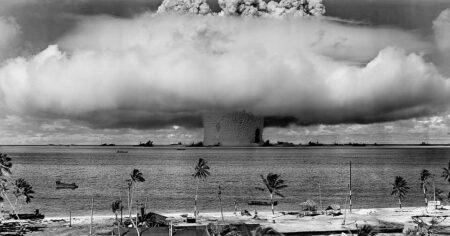
The year is 1958. Six years have passed since American scientists disbanded the Atomic Bomb Casualty Commission in Hiroshima, having gathered a wealth of data about radiation sickness. It is a supposedly a time of peace. Imagine you are 18 years old, embarking on a tour of National Service. You are shipped to Christmas Island, the furthest you have ever strayed from home. Your job is to stand on an idyllic white sandy beach and observe as scientists detonate nuclear bombs in the Central Pacific. When the signal is given, you follow an order to turn away from the blast and cover your eyes with your hands. There is no protective clothing. As the flash goes off, you can see your veins, your skin tissue, your bones, and through it all, diamond white, like a second sun. Searing heat builds inside you, until you imagine that there is only one way it can end.
Incomplete monitoring for exposure to radiation
An estimated 39,000 British and Commonwealth servicemen witnessed 45 atomic and hydrogen bombs, and hundreds more radioactive experiments. Some who remained in the service were ordered back to the island to help “clear up the mess”. Only 23% of the nuclear weapons’ test participants were monitored by dosemeter for ionising radiation, and 64% of the dosemeters didn’t register readings because they fell below the minimum.
While a number suffered radiation sickness immediately, some of whom died, others’ symptoms followed patterns seen in Hiroshima. They lost their appetites and ran high fevers. Their skin was a mass of “raw, weeping lesions” and their hair fell out in clumps. Some appeared to be fine for decades before developing cancers and other rare diseases.
Interestingly, among my team of 35 beta readers, three told me that their fathers or grandfathers had been at Malden Island or Kiritimati (Christmas) Island, where 14,000 military personnel were supported by 276 Fijian troops and two New Zealand Navy frigates. All had died prematurely, but neither they nor their families ever put two and two together. This was part of the difficulty. For the islanders, the legacy of nuclear testing became apparent by the mid-1960s, but the young men on National Service came home and dispersed. Legally bound by the Official Secrets Act 1911, their experiences remained a secret.
Many Atomic Veterans are proud to have served their country. Many (although not all) acknowledge that there is a strong need for a nuclear deterrent. However, given that the risks of exposure to radiation were either known or reasonably foreseeable, they had every right to expect that their government would take care of them if things went wrong. They couldn’t have imagined that the British government would introduce a higher burden of proof than other governments, so that their American counterparts received compensation and they did not. It should not be left to the Prime Minister of Fiji to step in and award each surviving veteran three thousand pounds, saying, ‘Fiji is not prepared to wait for Britain to do the right thing’.
Why is there such a large gap between official findings and the veterans’ lived experience?
This is one of the most debated aspects of this issue. It can’t be explained by a single factor—rather, it comes from a combination of scientific limits, missing data, legal standards, and possible institutional behaviour. Individual suffering doesn’t always translate into legal or scientific proof. If illness rates are only slightly higher, they may be judged “not statistically significant”.
In their quest for answers, the UK’s nuclear veterans have encountered barrier after barrier, told they must produce evidence by the very same authorities who should have been protecting them, and who repeatedly told them that they did not hold any records.
“Unlike the U.S. Department of Veterans Affairs, which offers MST-specific treatment and acknowledges its impact, the UK has no official framework to deal with it.” Forward Assist.
There is no doubt that at the time of the 1950’s tests, there was limited understanding of the effects of exposure to relatively low doses of radiation. Data on the long-term effects simply didn’t exist. As a result, military personnel were often exposed to fallout under conditions that were later considered unsafe. But it is clear that the government was aware there was a risk, and deemed it acceptable in order to further their understanding.
A study that confirms the impact on test participants is “not conclusive” is not the same as confirmation that harm didn’t occur. And large-scale scientific studies do not investigate how sub-groups might be affected, or consider rare conditions or family patterns.
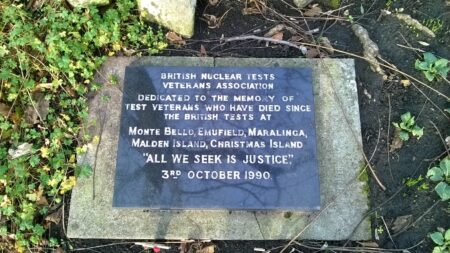
“All we seek is justice”
When I published my novel in 2016, I believed that the veterans and their relatives were very close to obtaining the recognition, support and compensation they so obviously deserve. The 70-year anniversary of the first British nuclear test came and went. A decade later, they are still fighting. But evidence collated by the Mirror newspaper pointed to a high-level cover-up.
It is something the veterans have long suspected – that the evidence they needed to prove their cases was there all along.
If proven, the implications would be profound, both legally and politically. The UK government, particularly departments such as the Ministry of Defence, could face large-scale compensation claims worth billions of pounds, not only from British veterans, but also from Commonwealth countries. It could also lead to criminal investigations into misconduct in public office, undermine court rulings, and raise serious questions about accountability over decades.
In the wake of Hillsborough and the Post Office Scandal, this would further undermine confidence in officialdom and government.
So how did we get here?
A timeline of critical dates
16 July 1945 – The United States conducted the first-ever nuclear test, exploding a 20-kiloton atomic bomb, Trinity, in New Mexico.
August 1945 – The US dropped atomic bombs on Hiroshima and Nagasaki. The explosions killed 220,000 Japanese citizens, with over 200,000 more dying after the events from lethal radiation overdoses.
1946 – The first underwater nuclear test — Operation Crossroads — was conducted by the US in the Pacific, to evaluate the potential for use of nuclear weapons in naval warfare.
1946 – The UN General Assembly established a commission to deal with problems related to the discovery of atomic energy, including controls to ensure it was only used for peaceful purposes.
1946 – The United States Atomic Energy Act of 1946 (McMahon Act) effectively ended technical co-operation with the UK and Canada, after which the British government initiated its development of nuclear technology.
1946 – 1949 – 12,000 New Zealanders took part in the occupation of Japan as part of the British Commonwealth Occupation Force. (“Jayforce”)
29 August 1949 – USSR detonated its first atomic bomb, “Joe 1”, marking the beginning of the “Cold War” nuclear arms race.
1950s – the US established a dedicated test site (Nevada Test Site).
1952 – The UK joined the nuclear powers and conducted its first test (Operation Hurricane) in Australia. It would carry out 45 tests between 1952 and 1991, 20 of which were exploded in the atmosphere. The UK’s tests didn’t just involve British personnel. Australia, the host nation, worked on test sites and played supporting roles. Its indigenous population was also exposed to the tests. The New Zealand Airforce participated in monitoring the radioactivity, conducting flights to the North and South of Auckland and a return flight to Suva. New Zealanders were also involved in visiting ground zero after detonation and for testing protective clothing. Fijian soldiers were also deployed in significant numbers, with many serving on Christmas Island.
1 November 1952 – the US became the first country to test a hydrogen bomb.
October 1953 – The UK conducted Operation Totem at Emu Field in South Australia, the purpose of which was to determine the “acceptable limit” of plutonium-240 in a bomb.
March 1954 – The US tested its 15 megaton hydrogen bomb Castle Bravo in the Pacific’s Marshall Islands, resulting in the worst radiological disaster in its testing history, with local civilians, servicemen stationed on Rongerik atoll, and the Japanese fishing trawler Lucky Dragon being contaminated with the fallout.
March 1954 – In the wake of the Castle Bravo detonation, secret research began on the “Response of Human Beings exposed to Significant Beta and Gamma Radiation due to Fall-out from High-Yield Weapons.” Controversially, research was conducted by the same teams who were supposedly providing medical care to exposed populations in the 75 days following exposure (an obvious conflict of interests), with follow-up and six and 12 months.
1954 – India’s Prime Minister Jawaharlal Nehru became the first statesmen to call for an international agreement to halt nuclear testing.
1955 – The results of the US’s study on the medical effects of radiation exposure were published in medical journals, such as the Journal of the American Medical Association. This concluded that while acute illness was rare, even low-level radiation could have latent health effects. From this point onwards, UK protections should have stepped up.
January 1957 – a UK war office memo stated that personnel selected “may be exposed to radiation” and would be medically examined for suitability and would be medically examined on their return to ensure they were fit to return to active duty.
10 October 1957 – A fire broke out at the Windscale plutonium production facility in Cumberland (now part of Cumbria), England. It remains the worst nuclear accident in the history of the United Kingdom. Radioactive iodine-131 and polonium-210 escaped into the atmosphere, contaminating farmland. Authorities banned milk distribution across roughly 200 square miles for several weeks. Later analyses linked the release to about 100 fatal and 140 non-fatal cancers, though early government reports minimized public health risks. This marked a pivotal moment in nuclear safety policy worldwide, demonstrating that the effects of radiation were well-known by this time.
1960 – National Service ended, having been phased out.
1960 – France became a nuclear weapons state.
1961 – The Soviet Union tested the 50 megaton “Tsar Bomba” at the Novaya Zemlya test site near the Arctic Circle.
1962 – Nuclear testing reached its peak, with 178 tests (96 by the US, 79 by the Soviet Union). Notably, the US carried out 24 of the tests near Christmas Island, under the code name, Operation Dominic.
1963 – Underwater nuclear testing was banned by the Partial Test Ban Treaty.
1964 – China became a nuclear weapons state.
1970 – The first suggestions of ill health in UK’s test participants were in 1970 (Hansard, 1970). There was a question mark over whether this was a consequence of test involvement, or the natural result of a population of fit young men passing into middle age.
1972 – Micronesian Representative Ataji Balos charged at the Congress of Micronesia that the US’s exposure of the indigenous population was pre-meditated and intentional, so that the AEC could develop medical treatment for those exposed to fallout during nuclear war. The US government contested this, advising that accidental exposure having occurred, it would have been irresponsible not to see what could be learned from it – albeit that it did not obtain informed consent from the victims to do so. But the same question should be asked of the British government in making a decision to involve so many service personnel.
May 1974 – India became the sixth nation to develop nuclear weapons, conducting a “peaceful nuclear explosion” using the bomb “smiling Buddha.”
1983 – In the UK, the National Radiological Protection Board was commissioned to undertake a full epidemiological study to investigate increased incidents of cancer in participants in the UK’s nuclear test programme, conducted by Dr Sarah Darby and Sir Richard Doll. They made the critical observation that test participants selected for foreign service were fitter than the general population and would be expected to have enjoyed better health. Therefore, a smaller variation could be significant.
1984 – The British Nuclear Test Vets Association was founded.
1984 – After investigative journalist Paul Foot raised the alarm, Richard Stott launched the Mirror’s campaign for the test veterans called ‘Atom Bomb Kids’, revealing the scale of the servicemen’s involvement in the testing, leading to questions in parliament. Thatcher ordered studies by the National Radiological Protection Board, which discovered elevated rates of leukaemia and cancers among the veterans “but not enough to merit a change in policy.”
1985 – Australia’s Hawke Labour government established the McClelland Royal Commission into British nuclear tests in Australia was an inquiry by the Australian government to investigate the conduct of the British in its use of Australian territory and soldiers for testing nuclear weapons. This followed a public outcry, led by media reports, over increasing evidence of premature deaths of former Australian staff associated with the atomic tests and subsequent birth defects in their children. Similarly, indigenous communities had suffered higher rates of radiation-related diseases not generally found among indigenous communities to the same level. The inquiry was told:
- The atomic agreement was put in place retrospectively, after the first test had been conducted.
- Warnings given to the indigenous communities were grossly inadequate.
- Safety measures feel short of those established at the time.
- 30 badly leaking drums of radioactive waste were dumped off the West Australian coast.
- The fallout was three times more than the forecast, with black cloud drifting over the mainland.
- One hundred Aboriginal people walked barefoot over contaminated ground because the boots they had been given didn’t fit.
- Levels of soil contamination were deemed dangerous 25 years after the testing.
- British scientists in high radiation zones were fully dressed in protective radiation suits that were not issued to Australian staff working in the same high-risk radiation zones.
1988 – The first epidemiological analysis of UK nuclear test participants and controls was published in 1988 as a paper (Darby et al., 1988b) and a detailed report (Darby et al., 1988a). It referred to raised rates of leukaemia and multiple myeloma that were “statistically significant”.
“Moreover, the leukaemia cases in test participants tended to be of the types known from other evidence to be associated with radiation exposure, rather than of chronic lymphocytic leukaemia.”
15 April 1989 – Hillsborough Disaster – A terrace crush at the FA Cup semi-final in Sheffield resulted in the deaths of 97 Liverpool fans. Whilst seemingly unrelated, the families’ ceaseless campaign for justice will result in proposals for what became widely known as the Hillsborough Law – a legal basis to hold public officials accountable.
6 November 1991 – the UK’s last nuclear test took place.
1993 – The second Darby report concluded that it was more plausible that the low rates of diseases in the control groups were due to chance (the random selection).
1993 – Two veterans took a claim over their health defects to the European Court of Human Rights, which rejected it. A year 2000 appeal to the court to reopen the case was declined.
1993 – Summary of date from environmental at Christmas Island, produced by the UK’s AWE and known as SDTN 16/93 or “the Clare report”.
“It points to elevated radiation not only in the environment but in fish, the very food servicemen were catching and eating regularly. With desalinated water in use, drinking supplies may also have been compromised. In a hot climate where food and water intake was high, exposure was not just external; it was likely ingested, compounding the risk of tissue damage and hereditary harm.” ~ Salford MP Rebecca Long-Bailey
January 1994 – The Conference on Disarmament (CD) began negotiations on a comprehensive nuclear-test-ban treaty.
1996 – the opening for signature of the Comprehensive Nuclear-Test-Ban Treaty (CTBT). As of now, the treaty has yet to enter into force.
1996 -NATO issued publication: “Radiation Exposure Guidance for Military Operations – ACE Policy for Defensive Measures against Low Level Radiological Hazards during Military Operations”
“(2). Low-level Radiation (LLR) exposure produces a risk to soldiers of long-term health consequences. The doses received from these exposures are higher than those routinely received by health physics workers and the general public and are in the range from background radiation to 70 cGy. The primary consequence of exposure may be induction of cancer in the longer-term post exposure. Additional health risks that may occur are teratogenesis and mutagenesis and their associated psychological and social consequences. The hazard from LLR may result from Alpha, Beta or Gamma radiation.”
1997 – AWE issued a briefing note to the Foreign and Commonwealth Office for use in a hearing at the European Court of Human Rights, stating that during Operation Grapple X, “there was no fallout on Christmas Island.”
1998 – The NRPB seven-page report was widely dismissed by veterans as a “whitewash,” with suggestions it was altered under official instruction.
1998 – The Nuclear Vets bid to be recognised by the European Court of Human Rights was denied, told it had no jurisdiction in the case.
1999 – Researcher Sue Rabbitt Roff at the University of Dundee tracked down and surveyed 2,500 veterans and their children, reporting unusually high rates of infertility and birth defects. The British government demanded more proof.
2000 – An appeal to the European Court of Human Rights to reopen the 1993 case from two Vets was declined.
2001 – The NZ Minister of Veterans’ Affairs published a statement it was “extremely unlikely” that their personnel’s deaths could be linked to observation of the UK’s nuclear tests.
2002 – The Sunday Mirror relaunched their campaign on the 50th anniversary of Operation Hurricane.
2003 – The third UK analysis of the effects of radiation exposure was published (Muirhead et al., 2003a, Muirhead et al., 2003b), conducted under an oversight Committee and, because of concerns expressed by Veterans’ Associations, focussed especially on multiple myeloma. Although it found no evidence for higher risks of multiple myeloma in participants, it found that leukaemia rates and rates of liver cancer were higher.
2000s (early – mid) – Groups like British Nuclear Test Veterans Association pursued legal claims against the Ministry of Defence, with thousands of veterans and families seek compensation for cancers, birth defects, and other conditions.
2006 – North Korea carried out its first nuclear test.
2007 – Two scientific studies demonstrated clear links. Firstly, a Massey University study of New Zealand nuclear test veterans found genetic damage at three times the normal rate – comparable to victims of the Chernobyl nuclear accident. Then, an independent study by Green Audit found significantly higher rates of miscarriages and stillbirths, infant deaths, childhood cancers, and inherited genetic deformities. They estimated that genetic birth defects will last for 20 generations, in other words, 500 years.
2007 – The New Zealand study “Cytogenetic Analysis of New Zealand Nuclear Test Veterans” (Massey University Genetic Study) found genetic damage 3× higher than expected in veterans, with blood disorders, miscarriages and infant mortality all been linked to radiation poisoning. The research revealed that nuclear test victims exhibited “a similar rate of DNA damage to clean-up workers at Chernobyl.”
2007 – 700 New Zealand and UK veterans launched a class action lawsuit against the British government claiming NZ $36 million in damages. The Ministry of Defence countered with a statute of limitations defence.
2008 – Following a parliamentary inquiry, the government agreed to fund new studies into the nuclear veterans’ health and agreed to pay interim compensation of £4,000 each.
2011 – An MoD health study indicated that 83% of survivors from the UK tests reported between one and nine chronic health conditions.
2012 – The UK Supreme Court rejected a civil claim brought veterans’ on the grounds of time limitation, ruling that there were no grounds for the Court to exercise its discretion to disapply the prescribed time limit, as the veterans’ claims had no real prospect of success. But in reaching this decision, it had relied on the Clare report as “one of the principle references in this case.” in other words, it had not seen the source material.
2014 – A member of the public requested radiation data from the Atomic Weapons Establishment (AWE). Internal review uncovered previously hidden data showing radiation contamination in inhabited areas and contaminated fish consumed by troops. A “whistleblower” draft report was produced and shared with the MoD but was not made public.
22 May 2014 – The Christmas Island Nuclear Tests Radiation Survey Report (one of the documents that was made public in 2016). Rather than rely on the Clare report, this review went back to the source material – the raw data from which the Clare report had been compiled. It found the original summary to have been “incomplete and, in some cases, factually inaccurate.” Specifically, it found that heightened radiation readings taken at Port Camp had gone entirely unrecorded in any previously known document, evidence which “could potentially be used to challenge the validity of statements made by AWE, MoD and HMG regarding the occurrence of fallout on CI.”
28 August 2014 – NEW ZEALAND OBSERVERS AND INDOCTRINEES AT NUCLEAR WEAPON TESTS: 1956-195
Mid-2010’s – The investigative journalist Susie Boniface emerged as a champion for the nuclear test vets, ensuring that their plight remained in the news.
2015 – Chancellor George Osborne announced £25 million “to help our eldest veterans, including nuclear test veterans.” But this wasn’t only for the surviving Atomic Veterans. At the time, approximately two million veterans were qualified to apply.
2015 – Fiji’s Prime Minister Frank Bainimarama awarded each surviving British veteran just over £3,000. At the ceremony, he stated: “Fiji is not prepared to wait for Britain to do the right thing.”
2016 – In a key war pensions case, judges ruled no “measurable radiation” was found and no widespread contamination occurred – conclusions that are now disputed.
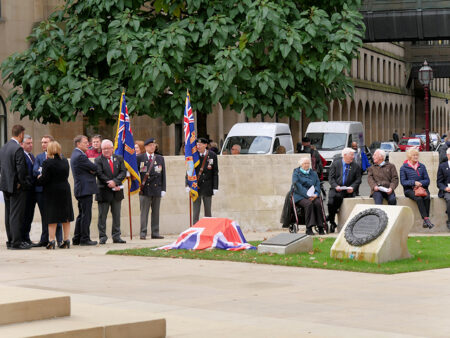
2017 – Unveiling of Nuclear Test Veterans Memorial, Manchester.
Mach 2017 – The Public Authority (Accountability) Bill was presented to Parliament with cross party sponsorship, but its progress was halted when the 2017 General Election was called.
22 May 2017 – Manchester Arena bombing.
14 June 2017 – Grenfell Tower Fire.
2018 – The nuclear test vets launched a high-profile campaign for a medal to recognise their service.
May 2019 – During a House of Commons debate on Christmas Island nuclear testing, Tobias Ellwood told the House that “none was exposed to direct radiation beyond the background radiation that was expected.”
Late 2010s – Groups like LABRATS continued lobbying for medals, recognition, access to medical records and a public inquiry
2020s – Campaigners pushed successive governments for justice. Keir Starmer (while in opposition) expressed support for veterans’ cause.
18 April 2021 – The BBC aired an episode of Call the Midwife featuring Derek Fleming, whose health problems were linked to exposure during Operation Grapple.
May 2021 – The National Radiological Protection Board confirmed that it had carried out three large-scale studies of nuclear test veterans and found “no valid evidence to link participation in these tests to ill health” and that the test participants “had similar overall levels of aggregated mortality and cancer incidence” to the control group.
It was confirmed that veterans’ blood and urine samples had been reclassified as “scientific data” and placed out of reach at the Atomic Weapons Establishment in a database known as Merlin. The data had not been declassified “contains information ranging from unclassified to Top Secret.”
“I would like to make clear that the Ministry of Defence, including its agencies and arm’s length bodies, does not withhold any personal data or medical records from nuclear test veterans.” ~ Defence minister, Andrew Murrison
December 2021 – Defence Secretary John Healey told MPs that “nothing is being withheld”, and that officials would carry out a “detailed dig” amid concerns from surviving nuclear test veterans.
February 2022 – Michael Gillies and Richard G E Haylock published their report on “Mortality and cancer incidence 1952–2017 in United Kingdom participants in the United Kingdom’s atmospheric nuclear weapon tests and experimental programmes.” It found only slightly increased risks (2%) when compared with the control group, but it also pointed out that only 23% of servicemen were monitored. It noted that a “Healthy Soldier Effect” is commonly seen, in which those selected for service in the armed forces show lower mortality than members of the general population.
2 April 2022 – the BBC’s Naga Munchetty interviewed the nuclear tests veterans and their families.
5 July 2022 – Brunel University headline: “Study finds no evidence of genetic legacy in children of UK’s nuclear test veterans.” The researchers analysed blood samples from 30 family trios (father, mother and their surviving biological child conceived soonest after the father returned from nuclear test sites) against a matched control group. This was despite congenital abnormalities in families of nuclear test vets.
2023 – A group of nuclear test veterans launched as new legal case for access to medical records held by the Ministry of Defence (MOD).
2023 – BBC News reported the discovery of documents that showed the MOD may have a number of medical files recording the results of blood and urine sample testing but, when veterans request these reports, they had been told they were “missing or incomplete.” The Government have said no records have been withheld from veterans and that these can be requested from the MOD.
November 2023 – The Parliamentary Under Secretary of State and Minister for Defence People and Families (Dr Andrew Murrison) made a commitment during the debate on Nuclear Test Veterans: Medical Records (Official Report, column 245WH) to personally review records held by the Atomic Weapons Establishment (AWE) relating to nuclear test veterans.
6 December 2023 – Justice Secretary Alex Chalk told the Commons that the government response was addressing all “25 points of learning” highlighted in Bishop James Jones’s 2017 report and there had been “a development in thinking”.
December 2023 – The government has signed a “Hillsborough Charter”, promising no family will suffer the same injustices as relatives of the 1989 disaster’s victims. The charter promises to implement a “duty of candour” for policing in England and Wales, which aims to promote a culture of honesty and transparency during investigations and inquiries. Former Labour minister Derek Twigg, who was at Hillsborough on the day of the disaster, told the Commons that the duty of candour needed a legal footing, otherwise it would be unenforceable.
8 January 2024 – The Daily Mail reported; Outrage as Government admits it kept medical results on nuke test veterans a ‘state secret’ in a move Tory grandee Sir John Hayes said ‘beggars belief’. The records are said to include blood and urine samples from servicemen, civilians and indigenous people during the Cold War.
2024 – The Pact for the Future, was adopted at the 2024 Summit of the Future, containing the first multilateral recommitment to nuclear disarmament in over a decade.
2024 – In response to questions raised by members of the nuclear test veteran community, the Minister for Veterans and People commissioned an exercise to examine information held by the Ministry of Defence (MOD) in relation to participants of that programme.
July 2024 -The New Study of UK Nuclear Test Veterans report is published.
May 2024 – 151 MoD files were declassified, revealing 4,000 pages of evidence about an uninformed medical monitoring programme of nuke test veterans. The AWE insisted it did not hold any documents about blood or urine testing “above the 151 documents that have already been released”.
21 May 2024 – The Earl of Minto read a statement in parliament confirming that The Parliamentary Under Secretary of State and Minister for Defence People and Families (Dr Andrew Murrison) was publishing papers following his review of 151 records held by AWE on gov.uk and placing them in the Library of the House. “The Merlin database contains over 28,000 records relating to historical technical and scientific documentation on the UK’s nuclear testing programme. It is held and maintained by AWE and was developed to store relevant factual documentary evidence considered during nuclear test veterans’ legal action for compensation. The Merlin database does not contain, and AWE does not hold, any medical records for any former Service personnel.” “Concurrently, the Ministry of Defence is also conducting a review of around 74,000 historic files in the ES and AB series relating to the UK’s nuclear weapons programme. This work has been speculated to relate to the concerns of nuclear test veterans, which is not the case. The files were withdrawn from the National Archives to be reviewed due to emerging national security considerations. To date, approximately 68,000 files have been released back to public access. As this security review has progressed, those records which may relate to historic testing have been, and will continue to be, prioritised.”
“I would like to make clear that the Ministry of Defence, including its agencies and arm’s length bodies, does not withhold any personal data or medical records from nuclear test veterans.”
19 September 2024 – Susie Boniface reported in The Mirror that the newspaper had uncovered a “special directive” from the office of a junior defence minister for MoD staff to remove medical records of British troops who took part in nuclear weapon trials in Australia and the Pacific as campaigners called for an investigation into possible crimes. 4,000 pages of documents reveal the blood and urine testing of troops, which the MoD had claimed never happened. The MoD is forced to admit its own lawyers may have had the truth hidden from them.
“If proven, millions of pounds were wasted on decades of government litigation which could have been used to compensate victims. It appears likely the Supreme Court, High Court and European Court of Human Rights, as well as coroners and war pension judges, were misled. The Atomic Weapons Establishment now stands accused of orchestrating the longest scandal in British history, with the help of politicians and officials who refused veterans’ pleas to investigate.” ~ Susie Boniface
30 October 2024 – Researcher Christopher Hill wrote in the Diplomat that one of the detonations on Kiritimati “cracked the walls of [people’s] homes and smashed their doors and furniture.”
2024 – Britain’s Nuclear Bomb Scandal: Our Story (BBC Two, 2024) examined the impact of testing on Indigenous communities, and included first-hand testimony from veterans and evidence of long-term illness and birth defects.
15 September 2024 – Britain’s Atomic Bomb Scandal (Channel 4, 2024): Another major investigation into veterans’ exposure during tests.
24 September 2024 – Sir Keir Starmer pledged that a “Hillsborough law” will be introduced in Parliament before the next anniversary of the 1989 football stadium tragedy.
November 2024 – The Nuked Blood Scandal was featured in a 75-minute BBC documentary.
18 March 2025 – Susan Boniface reported in the Mirror that at least 250 medical monitoring files amounting to an estimated 10,000 pages were withheld from Parliament. A “filing error” is blamed.
“It’s becoming clear that the shroud of secrecy around the nuclear test programme is now not protecting us from foreign malign influences, but protecting the government from its duty of responsibility to our nuclear test veterans.” Veterans lawyer, Jason McCue
Officials have blamed the mistake on a filing error, but it raises questions as to whether ministers are being told the truth about the extent of radiation experiments on servicemen during the Cold War.
4 April 2025 – The Mirror reported that nearly one million pages of evidence about Britain’s Cold War radiation experiments involving its own troops will finally be made public.
15 April 2025 – The government announced that more time was needed to draft the best version of the Hillsborough Law.
22 June 2025 – Susie Boniface reported in the Mirror that a medical officer’s journal has revealed that troops were given “unnecessary x-rays” on their way to take part in Britain’s first atomic bomb test.
(Timeline continues below image)
25 June 2025 – Andy Burnham tells the BBC that the truth about UK nuclear veterans was ‘covered up for decades’. The MoD has promised to “thoroughly examine” what information exists regarding veterans’ medical tests.
“This is a criminal cover-up on an industrial scale and only Parliament can overturn it. Why has this one got the firmest of lids on it? I think it is because it goes to the heart of the British state.” ~ Andy Burnham
25 July 2025 – Susie Boniface reported in the Mirror that The Met had joined Thames Valley Police to assess allegations about the MoD’s illegal cover up of evidence of nuclear experiments on troops. Boris Johnson and Keir Starmer were on a list of potential witnesses.
16 September 2025 – The government introduced the Public Office (Accountability) Bill, commonly known as the Hillsborough Law, into Parliament.
19 January 2026 -The Hillsborough Law was due to have its delayed third reading, but amid backlash from Labour MPs who claimed that the “duty of candour” was watered down when it came to the security services, it was pulled at the last minute – before the Victims’ minister Catherine Atkinson confirmed there would be “no carve out” for the security services.
14 March 2026 – The Mirror publishes evidence that the Atomic Weapons Establishment and Ministry of Defence colluded to cover up radiation risks, suppressing data on at least 15 occasions that confirmed at least 7 x normal level of radiation in fish, the sea, drinking water and air. Evidence was even hidden during court cases. As a result, lawyers submit complaints to Thames Valley Police alleging perjury, misconduct in public office, fraud and conspiracy. Police confirm they are reviewing newly submitted material.
“This strikes at the heart of the rule of law. The Prime Minister must ensure the truth is dragged into the light, and give insiders the protection to speak out. He must fast-track the special inquiry veterans demand, and the police must ensure that those responsible are brought to justice.” ~ Jason McCue, Solicitor
19 March 2026 – Veterans’ campaigner and former Labour MP Tom Watson posted in his newsletter, under a heading “A bomb in the Pacific, a lie in Whitehall.”
Reigniting the Debate
20 March 2026 – Writing on Substack, Oli Troen, a senior associate of McCue Jury & Partners acting for test veterans and their families, argues the document suggests a long-standing institutional attempt to deny the extent of radioactive fallout at Kiritimati, by classifying a report as a “draft”.
On 25 March 2026, the issue was debated in the House of Commons. You can read the transcript here.
“Initial investigations show that parts of the Ministry of Defence were made aware of the report in 2014, as were Government legal representatives. It is not yet established whether Ministers were made aware at the time.” Louise Jones, The Parliamentary Under-Secretary of State for Defence
‘One of the gravest state injustices of our time’ ~ Salford MP Rebecca Long-Bailey
2 April 2026 – Susie Boniface reports that in 1985, scientists deliberately removed evidence of more than 1,000 troops given a radiation dose from an official government study cancer and mortality study.
7 April 2026 – London human rights law firm McCue Jury & Partners has obtained documentary material that it claims exposes as lies decades of official assurances denying radioactive fallout and exposure.
Now the UK’s atomic veterans who called themselves ghosts will almost certainly come back to haunt the government. The first question they want to know the answer to is exactly when the Ministry of Defence became aware of the 2014 review’s conclusions, and whether it then briefed government ministers on its findings.
13 July 2026 – Steve Foote and Alan Owen of Labrats spent 7 hours in the MOD building viewing the missing medical evidence report and met with Andy Burnham to share what they had learned.
14 July 2026 – The proposed Public Office (Accountability) Bill passed unanimously by MPs at third reading in the Commons. Speaking in the Commons, Andy Burnham called on MPs to listen to nuclear test veterans’ demand for a special one-year tribunal to look at their experiences, arguing it is “entirely consistent with the aims of the Bill we are passing tonight”.
14 July 2026 – The MOD publishes its Records exercise into blood and urine testing of UK Service personnel during the UK’s nuclear testing programme (1952 – 1967): A discovery exercise into blood and urine testing policy during the UK’s nuclear testing programme (1952 – 1967).
“We cannot allow the MOD to investigate itself any longer. We demand:
17 July 2026 – Labrats publish ‘Inside the MOD’s Nuclear Test Records Disaster’, listing their demands:
- A full and honest apology for both the original actions and subsequent cover-up.
- A national memorial to recognise those affected and ensure the legacy is never forgotten.
- Education within schools to improve public understanding for future generations.
- Comprehensive genetic research to identify all affected individuals and understand the full impact on descendants and future generations.
- Financial redress for the affected families.
- A full independent fast-track inquiry into the nuclear testing programme and its consequences.”
29 August 2026 – Campaigners and veterans’ organisations publicly called on Andy Burnham to deliver justice for nuclear test veterans, timed around the UN’s International Day against Nuclear Testing.
3 September 2026 – “An absolute cover-up”: Former veterans minister Tobias Ellwood has accused the Ministry of Defence of deliberately withholding nuclear test veterans’ medical records. He now believes that information he gave to Parliament in good faith was “a complete lie” and has joined the fight for justice.
6 September 2026 – Wes announces that those who were exposed to atomic radiation will receive compensation of £30,000 each – less than the £50,000 pledged by Labour in its 2019 manifesto.
Press

Want to be featured?

Host a bookclub
Latest books











Read an excerpt

Author Member of The Alliance of Independent Authors
