
What made Lackington’s the ideal publisher for Mary Shelley’s Frankenstein?
Not a coincidence, but a culmination
When Frankenstein; or, The Modern Prometheus appeared anonymously in January 1818, its title page read:
London: Printed for Lackington, Hughes, Harding, Mavor & Jones, Finsbury Square.
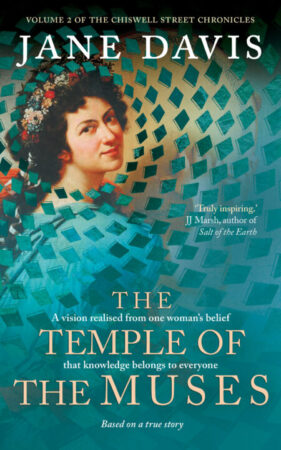
At first glance, the connection between Mary Shelley’s novel and the sprawling London book emporium known as The Temple of the Muses might seem accidental. But Lackington’s didn’t only sell books. It published them. And Lackington’s was the most natural publisher imaginable for Frankenstein — both because of its own history (the story I tell in The Bookseller’s Wife and The Temple of the Muses) and because of its long association with Percy Bysshe Shelley, Frankenstein’s champion and editor.

Source Wikimedia Commons, public domain
The Temple of the Muses: A Radical Bookshop for the People
Opened in 1794, but with deeper roots dating to the 1770s, Lackington’s The Temple of the Muses on Finsbury Square was one of the marvels of Georgian London: a domed palace crammed with “literature for the people.” James Lackington had revolutionised the book trade by refusing to offer customers credit and selling at minimal profit, issuing catalogues that listed tens of thousands of titles — everything from devotional tracts to the most incendiary works of philosophy. His motto was “Small profits do great things.”
Percy Shelley and his patronage of Lackington’s (1810–1811)
By 1810, the time of Percy Bysshe Shelley’s arrival at Oxford University, Oxford, James Lackington had handed over the reins of the business to his third cousin George, and his partner, Robin Allen. But the firm (trading as Lackington, Allen & Co.) retained its radical reputation, stocking and publishing atheistic, deist, and revolutionary writers, whose works the universities shunned.
For young readers hungry for forbidden fruit, Lackington’s catalogue was a passport to intellectual rebellion. The university library offered theology and classics, but Percy Shelley wanted chemistry, materialism, and political philosophy.
Letters dating from late 1810 and early 1811 show him writing to his friend Thomas Jefferson Hogg about ordering books from Lackington’s:
“Have you written to Lackington’s? I want you to get me some books from them—Holcroft’s Travels, and Godwin’s Political Justice if it is not too dear.”
— Letters of Percy Bysshe Shelley, ed. Frederick L. Jones, I, p. 5.

Percy Shelley quickly became obsessed with unorthodox ideas. Soon he was begging for Holbach’s System of Nature (6 s.), Paine’s Age of Reason (1 s.), Priestley’s Matter and Spirit, and Darwin’s Zoonomia, supplied from Lackington’s vast stock of over 800,000 books.
As Kenneth Neill Cameron wrote in The Young Shelley:
“Lackington’s catalogue was Shelley’s first real syllabus of free thought — the printed key to that subterranean world of materialist and revolutionary philosophy which Oxford could not teach him.”
To an Oxford undergraduate, these banned books of the day were blueprints for a new, scientific, self-liberating world view, and their ideas flowed into his poetry and Mary Shelley’s conception of Frankenstein’s “modern Prometheus.”
By 1811, with Shelley in his nineteenth year, his reliance on Lackington grew. Not only did it furnish him with books. It distributed his book St. Irvyne; or, The Rosicrucian (1811), reaching sympathetic audiences for controversial material.
The Godwin Shelley Connection
The writer Percy Shelley idolised was, of course, Mary’s father. Percy Shelley first wrote to William Godwin in 1811, describing himself as a devoted disciple. Shelley and Godwin began meeting in 1812. By 1814 Percy Shelley was a daily visitor at Godwin’s home, having become infatuated with his daughter, Mary. Godwin educated all his children, making no distinction between daughters and sons. But as well as formal lessons, Mary had the advantage of exposure to London’s intelligentsia who made up Godwin’s social network, from poets and philosophers to scientists – including Humphry Davy and William Nicholson, two pioneering experimenters with galvanic electricity. Mary’s combination of beauty, intellectual heritage and intelligence proved irresistible to married Shelley. He assumed that because Godwin expressed anti-marriage views in his writing, he might approve of their relationship. He was wrong. In July 1814, the couple eloped.
From Percy’s Bookseller to Mary’s Publisher
Fast-forward to 1816 and a well-known chapter of literary history. Percy Shelley and Mary Godwin and their infant son William are once again abroad. They are guests of Lord Byron at Villa Diodati, near Lake Geneva, Switzerland. Also in the party are Mary’s step-sister, Claire Clairmont (pregnant with Byron’s child), and Byron’s physician, John Polidori. It is June, but the so-called “Year Without a Summer” was unusually cold due to the eruption of Mount Tambora.
Mary writes to an acquaintance:
“The lake was lit up—the pines on Jura made visible, and all the scene illuminated for an instant, when a pitchy blackness succeeded, and the thunder came in frightful bursts over our heads amid the darkness.”
To entertain his guests, Byron suggested they read ghost stories to each other and then each member of the party would write one of their own. Few evenings have been so productive. Polidori produced The Vampyre (the first modern vampire story). And Mary Shelley told a story unlike any story that had been told before – Frankenstein.
The Gothic novel that followed was informed by a keen interest in science. As well as having been familiar with two pioneers in electrical galvanisation, Mary recorded in her journal in 1714 that she attended Garnerin’s lecture on electricity, the gasses and the ‘phantasmagoria’. Some sources have her attending a talk given by Andrew Crosse at Garnerin’s lecture rooms, during which he explained how he utilised electrical energy created during thunderstorms.
But Frankenstein’s origins are not purely scientific. The novel was also informed by a hard-won awareness the fragility of life. In 1815, Mary gave birth to a premature daughter, who lived for just a fortnight. While writing the novel, she was caring for her son William. By the time Frankenstein was ready for publication, she had given birth to and lost another daughter, and both her half-sister, Fanny, and Shelley’s wife, Harriet, had taken their own lives. While Percy Shelley’s negotiations with Lackington’s were ongoing, Mary notes in her journal that she was again ‘confined’, having given birth to their daughter, Clara, on 2nd September 1817. All these events – the births and the deaths – would shape the final draft. How could it be otherwise?

A publisher who is not adverse to risk
The Shelleys (the couple married in on 30 December 1816) needed a firm willing to take a risk on an anonymous, unsettling book that mixed science, atheism, and horror. Lackington, Hughes, Harding, Mavor & Jones was not their first choice (John Murray and Charles Ollier rejected the book.) But it was the logical choice. Lackington’s already knew Percy Shelley personally — they distributed his St. Irvyne. Their list included speculative fiction, Gothic tales, and philosophical romances. Their customers were precisely the audience Frankenstein needed: educated, curious people with an interest in science, imagination, and controversy. And, perhaps most importantly, they were willing to risk publishing a radical novel that questioned creation itself.
Not a coincidence, but a culmination
So when Frankenstein appeared in January 1818, the publisher’s name on the title page was not a coincidence but a culmination. Lackington’s had been the bookseller who supplied Percy Shelley’s forbidden reading at Oxford, the distributor of his youthful fiction; and the kind of radical firm unafraid to launch an audacious new novel. Plus, they knew how to market the book to their readers.
A two-page advertisement bound into many copies of Frankenstein, named other books published by Lackington’s including Francis Barrett’s The Magus; or Celestial Intelligences; a complete System of Occult Philosophy, being a Summary of all the best Writers on the subjects of Magic, Alchymy, Magnetism, the Cabala &c. … [1801]; [Francis Barrett’s] Lives of the Alchemystical Philosophers. . . [1815]; Joseph Taylor’s Apparitions; or, the Mystery of Ghosts, Hobgoblins, and Haunted Houses … [1814]; and Sarah Utterson’s translation and adaptation of Tales of the Dead and the English translation of Eyriès’ Fantasmagoriana, the very volume that may have inspired the ghost-story competition.
In a sense, Frankenstein was born in the same intellectual marketplace that had once sent The System of Nature and Political Justice to an eager nineteen-year-old in Oxford. The creature’s origins were scientific, philosophical — and, fittingly, commercial, in the most progressive of London bookshops.

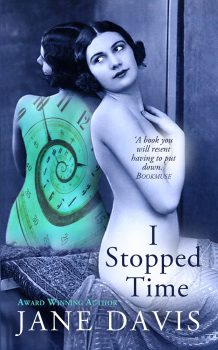
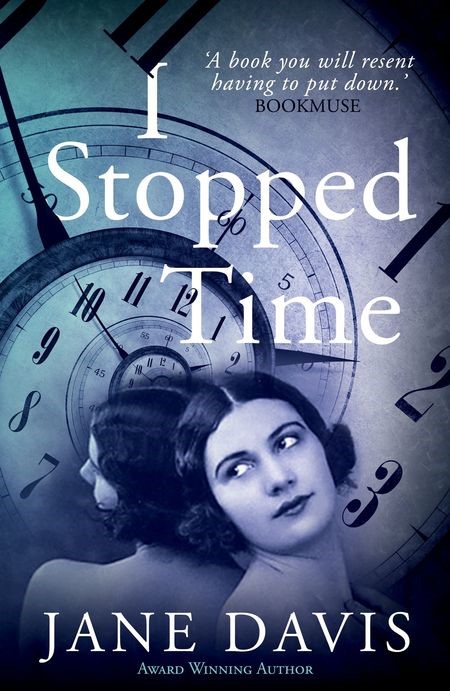
To have future posts delivered directly to your in-box, visit the sidebar on the right and subscribe to my blog, or to find out about new releases, competitions and freebies, subscribe to my newsletter and I will send you a free copy of my novel, I Stopped Time, as a personal thank you.
While I have your attention, can I please draw your attention to my updated Privacy Policy. (You may have noticed, they’re all the rage.) I hope this will reassure you that I take your privacy seriously.
Remember, if you enjoyed this post please share it.
If you have subscribed to my blog but no longer wish to receive these posts, simply reply with the subject-line ‘UNSUBSCRIBE’ and I will delete you from my list.
Press
Want to be featured?

Host a bookclub
Latest books







Read an excerpt
Author Member of The Alliance of Independent Authors
