
Georgian London After the Gordon Riots
A City in Chaos

In the early summer of 1780, London erupted in one of the most violent chapters of civil unrest in British history. What began as a protest against proposed relief for Catholics spiralled into days of destruction, looting and terror that left swathes of the city in ruins.
The Gordon Riots were more than a sudden explosion of anger — they exposed deep tensions simmering beneath Georgian society, and not just between Protestants and their Catholics neighbours.
It was by no means the first time that Londoners had resorted to riot over matters of religion. On 14th October 1710, riots began with the watch-word of “Sacheverell and High Church, and “the mob beat off the Constables with brands from the numerous bonfires they had lighted.” There are also various accounts of effigies of the pope being burnt, including this one from Protestant Postboy, 20th November 1711. .
"Having entertained the thronging spectators for some time with ingenious fire-works, a very great bonfire was prepared at the Inner Temple-gate; and his Holiness, after some compliments and reluctances, was decently tumbled into the flames; the _Devil_ who till then accompanied him left him in the lurch, and, laughing, gave him up to his deserved fate.This last act of his Holiness's tragedy was attended with a prodigious shout of the joyful spectators. The same evening there were bonfires in most streets of London, and universal acclamations, crying, "Let Popery perish, and Papists with their plots and counter-plots be for ever confounded. Amen." ~
“London is, and always has been, a city of stark contrasts. Those who have and those who have not.” The Bookseller’s Wife
“A city of concentric circles, the centre for the rich, the outskirts for the poor, and beyond, for the unfortunates who dwell in places designated as dumping-grounds for the population’s garbage.” The Bookseller’s Wife
In their aftermath, London was shaken to its core, struggling to restore order and rebuild trust.
For those living through them, the riots changed everything.
The Spark That Ignited the City
Unrest was sparked – some said provoked – by Lord George Gordon, who led the Protestant Association in opposition to the Catholic Relief Act of 1778. This law aimed to reduce the harsh penalties placed on Catholics, allowing them greater freedoms in property ownership and military service. But many saw these concessions as dangerous.
On 2 June 1780, a 50,000-strong crowd marched on Parliament carrying a petition to to demand the law’s repeal. When politicians refused to hear the petition – and the right to petition was something every Englishman held dear – tensions quickly boiled over, anger turning swiftly into violence.
What followed was nearly a week of chaos.
London in Flames
The mob swept through the city, attacking Catholic homes, chapels, and businesses. Buildings were looted and burned, with fires lighting up the night sky.
Violence soon spread beyond religious targets. Wealthy homes, government buildings, and anyone associated with authority became fair game. Rioters stormed prisons and freed prisoners. Newgate Prison — one of London’s most notorious jails — was completely destroyed.
For ordinary Londoners, fear ruled the streets. Families barricaded themselves inside their homes. Shopkeepers hid their goods. The wealthy moved their valuables to the Bank of England’s vaults. The sound of shattering glass and roaring flames echoed through parishes night after night.

A City Under Military Rule
As the riots spiralled out of control, the government called in the army.
Troops were ordered to fire on crowds if necessary — a desperate measure in a time when soldiers didn’t usually intervene in civilian matters.
By the time order was restored, hundreds had been killed or injured, and vast parts of London lay in ruins.
The city had survived war and plague in centuries past, but this was different. Destruction came from within.
The Aftermath: Fear, Poverty, and Opportunity
In the weeks that followed, London was a wounded city.
Burned buildings stood as blackened shells. Businesses had been destroyed. Many families were left homeless and without livelihoods. Some escaped with nothing more than the clothes on their backs. Once again, the destitute flocked to Moorfields, where they set up camp, just as they had done after the Great Fire.
There was also a lingering sense of unease. The riots had revealed just how fragile social order was — and how quickly anger could be unleashed when people felt powerless or unheard. The government chose to make examples of ring-leaders, setting up temporary gallows so that they could be hung in the parishes in which they had made their homes.
"The effervescence of June 1780 spread like a torrent through every avenue of the Metropolis, and convulsed every quarter of the Kingdom. That one man should accomplish such an effect, and that his weapon should have been intolerance
only, where tolerance is one of the gems which distinguish England from all Europe, is most astonishing. Our Legislature, acting upon the long-approved system of religious benevolence, would have erased from the Statute-books those restrictions which were calculated to repress a powerful enemy, and which had become useless through the lapse of time and the cessation of hostility; yet, Protestants objected, and acted the part of tyrants and bigots marshalled by a madman." Anecdotes of the Manners and Customs of London during the Eighteenth Century by James Peller Malcolm
Yet amid the devastation, change was already stirring.
A Society Ripe for Change
The late 18th century was a time of enormous transformation. The Industrial Revolution was beginning to reshape work and cities. Enlightenment ideas about liberty, reason, and education were spreading across Europe.
For many in London’s crowded streets, life was harsh. Poverty was widespread, and opportunities for advancement were limited. But there was growing belief that knowledge — especially reading — could offer a path to improvement. Books, however, remained expensive luxuries.
And that is where revolution quietly took root.

When Books Became a Beacon of Hope
Unrest accelerated conversations about social justice, governance, and the role of education in shaping society.
And in a modest bookshop in Chiswell Street, a quiet revolution was already underway. James and Dorcas Lackington believed that reading could transform lives. By selling books cheaply and in large numbers, they challenged the long-held idea that literature belonged only to the wealthy and educated elite.
They pledged to sell books for the lowest price possible while still making a profit. For the first time, ordinary people — apprentices, labourers, servant girls — could afford to own books.
In a city shaken by chaos, the Lackingtons offered the promise of a better future. This is their story.
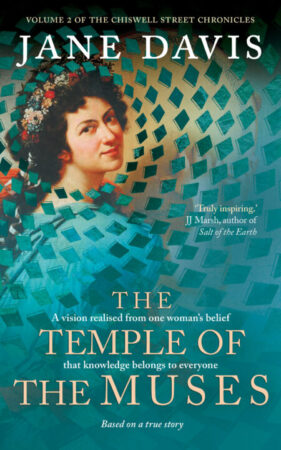
The Temple of the Muses will be released in ebook on 2 March 2026 and in paperback on 2 April 2026. Available for pre-order now!

Other novels that feature the Gordon Riots
- Barnaby Rudge: A Tale of the Riots of Eighty by Charles Dickens — The most famous fictional depiction, centered on the Gordon Riots.
- Harrington by Maria Edgeworth (1817) — Includes scenes set around the Gordon Riots.
- The Masters of Bow Street by John Creasey (1974) — Features the Gordon Riots as part of its plot.
- Sharpe series by Bernard Cornwell — In the series, the protagonist’s backstory involves his mother’s death during the riots.
- A Life Everlasting by Miranda Hearn (2003) — Historical novel with protagonists caught up in the riots.
- Pamela’s Hero: A Story of the Gordon Riots by Dorothea Moore (1908) — A historical novel set during the riots.
Press

Want to be featured?

Host a bookclub
Latest books









Read an excerpt

Author Member of The Alliance of Independent Authors
